
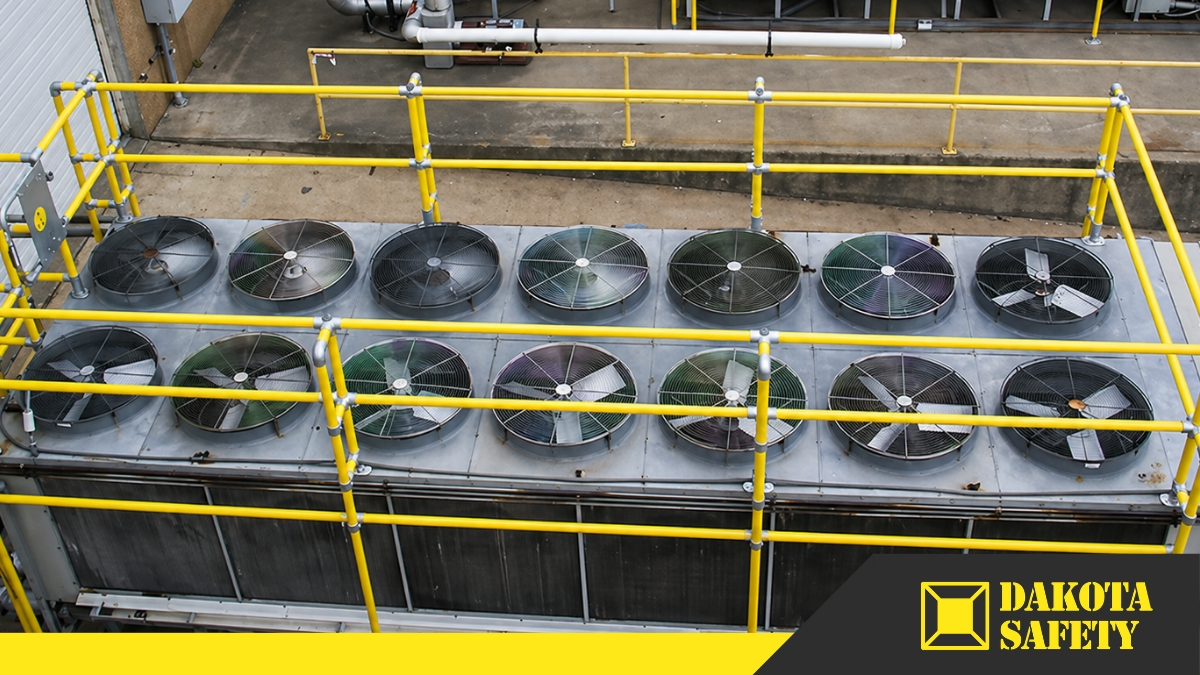


The calls follow the same pattern. A facility engineer needs fall protection for technicians servicing a chiller, the highest point on the roof or sitting on a concrete slab at grade, with no anchor points overhead and nothing to tie off to. The HVAC contractor quotes a custom-fabricated guard. The number comes back five figures. The timeline stretches past two months. The engineer starts looking for a modular enclosure that costs less and installs faster.
The other option facilities consider is an engineered tie-off system. On paper it sounds simpler. In practice it carries cost that often runs comparable to a custom-fabricated guard, plus a requirement that every technician maintain harness training, certification, and documented fit testing under 29 CFR 1910.132(d). The math gets worse, not better.
That search usually leads to a legitimate question: will a modular system actually pass OSHA?
Quick Answer: Both custom-fabricated and modular chiller guard enclosures can be OSHA-compliant when properly designed and installed to meet 29 CFR 1910.29 guardrail criteria: 42-inch top rail height, 200-pound force resistance, and proper midrail spacing.
OSHA's standards are performance-based. They specify what the system must do, not how it must be built. A 2014 OSHA letter of interpretation confirmed that the spacing of posts between sections of a freestanding modular guardrail system does not violate any standard, provided the system meets the 200-pound force requirement.
The Real Hazard on a Rooftop Chiller
The safety issue is not workers falling into a chiller. The issue is workers climbing on top of one.
Chillers are often the highest working surface in their location. On a rooftop, the chiller is typically the high point. On a ground-level slab, the unit may sit 9 to 12 feet above grade. Either way, technicians access the top for condenser fan service, electrical panel inspection, and refrigerant line work.
Under 29 CFR 1910.28(b)(1), employers must provide fall protection when employees work on a surface with an unprotected side or edge four feet or more above a lower level.
A guardrail that works on the day a technician forgets the harness is worth more than a harness program that works only when everyone remembers.
What a Custom-Fabricated Chiller Guard Is
A custom-welded chiller enclosure is exactly what it sounds like: structural steel members designed, cut, welded, and finished for a specific unit in a specific location.
That process typically takes months from first measurement to final sign-off. It requires certified welders on site, hot-work permits, fire-watch personnel, and often crane coordination to lift prefabricated sections into place.
What a Modular Chiller Enclosure Is: Dakota Safety's EquipGuard System
Dakota Safety's EquipGuard system is a modular guardrail enclosure purpose-built for chillers, rooftop equipment, ovens, and other elevated equipment that requires fall protection. The system is built on Tractel's KwikGuard structural pipe-and-fitting platform and configured by Dakota Safety as a packaged solution for elevated equipment protection.
EquipGuard is mechanically attached to the chiller's support structure or the slab at ground level. It never attaches to the chiller unit itself and never penetrates the roof.

Typical modular installation: no welding, no crane, no hot-work permit. A two-person crew with a drill and a band saw can assemble a standard chiller enclosure in a single day.
Custom-Fabricated vs. Modular Chiller Guards
| Dimension | Custom-Fabricated | Modular (EquipGuard) |
|---|---|---|
| Design process | Site-specific shop drawings, engineering review. | Standard component configuration with assembly drawing. |
| Typical timeline | Months, with sequential design, fabrication, coating, and installation. | Days to weeks, with configuration, shipping, and installation moving in parallel. |
| Installation method | Certified welders, crane, hot-work permits. | Drill, band saw, hex-key assembly, two-person crew. |
| Attachment | Often welded to structure, may require roof penetrations. | Mechanically attached to chiller support structure or slab, never to chiller or roof. |
| Relocation | Cut down and scrap when chiller changes. | Disassemble and reconfigure. |
Get a Scope-and-Cost Comparison Within 48 Hours
Send us your chiller dimensions, the manufacturer product specifications, and the field-measured installation height of the unit above the roof deck or slab. Dakota Safety can deliver a scope-and-cost comparison within 48 hours at no charge.
Request a comparison Call 866-503-7245Frequently Asked Questions About Chiller Guard Enclosures
Are modular chiller guardrail systems OSHA compliant?
Yes. OSHA's guardrail standards at 29 CFR 1910.29 and 1926.502(b) are performance-based. Any system that meets 42-inch top rail height, withstands 200 pounds of outward or downward force, and maintains proper midrail spacing is compliant, regardless of construction method.
How long does it take to install a modular chiller enclosure?
A modular system typically installs in a single day for a standard chiller unit. Total project timeline from order to installed protection runs days to a few weeks, versus months for custom-welded fabrication.
Will a modular chiller guard damage my roof or void the warranty?
No. The EquipGuard system mechanically attaches to the chiller's support structure or the slab at ground level, never to the chiller unit itself and never to the roof.
Can a modular chiller enclosure be relocated?
Yes. The EquipGuard system disassembles with the same hand tools used for original installation. When a chiller is replaced or moved, the enclosure can be reconfigured around the new unit.