
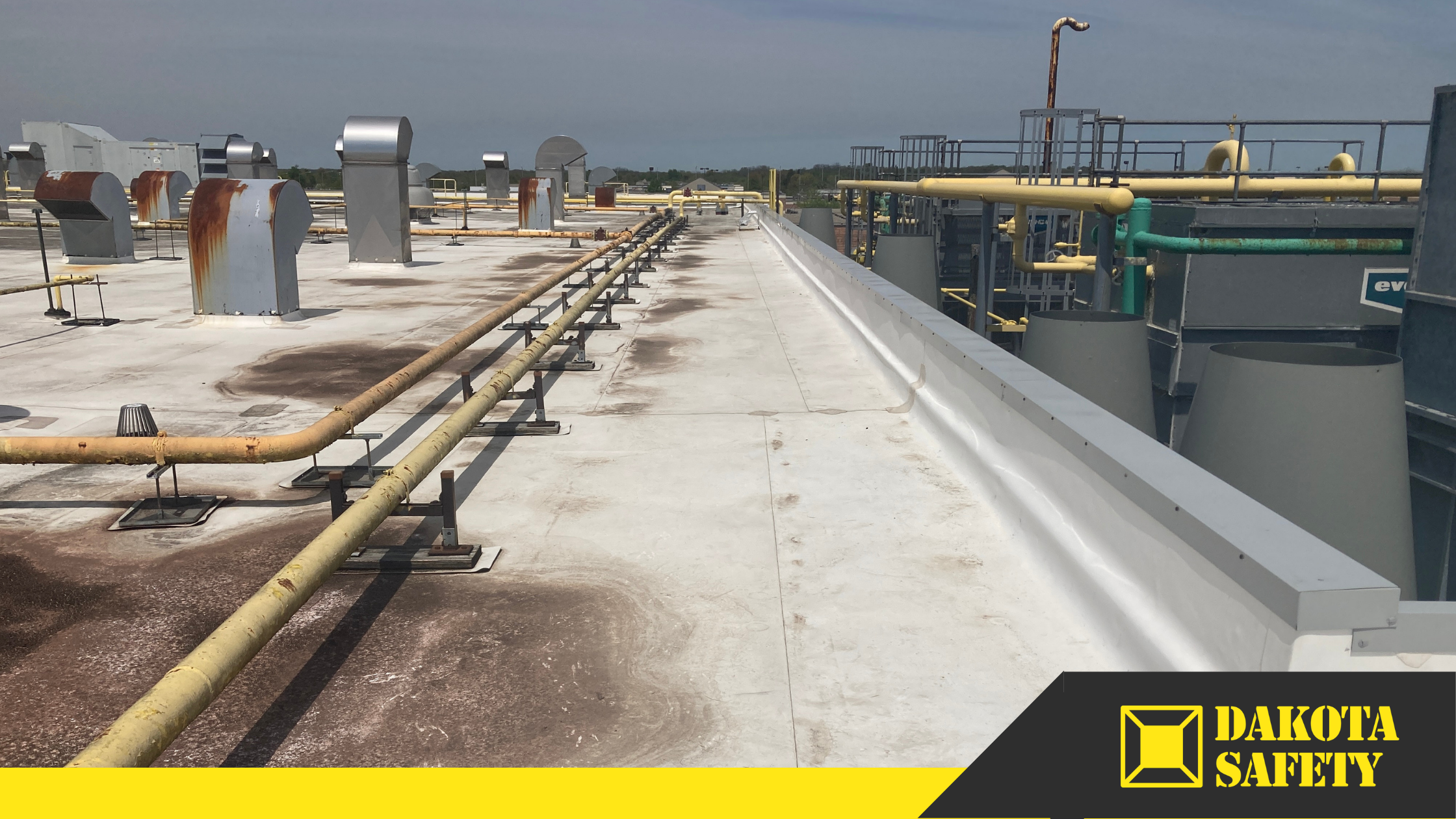


Most calls start with the same uneasy feeling: someone knows the roof is not as safe as it should be. A safety manager flags an exposed edge. A reroofing project creates a chance to bring the building up to current standards. New mechanical equipment changes the service route. Or a facility manager walks the roof often enough to know the next inspection could be a problem.
The goal is usually simple: give crews a safer way to access and service rooftop equipment without relying on harnesses every time they step outside. When a guardrail, gate, cover, or protected walkway can remove the exposure, the facility is no longer depending on perfect worker behavior to control the hazard.
Bottom line: A professional fall protection assessment is not a quick walk-around. It combines document review, virtual roof mapping, on-site hazard identification, OSHA standards mapping, root cause analysis, and engineered remediation options so your team can prioritize fixes and document good-faith compliance efforts.
Fall protection remains one of the most visible enforcement issues in workplace safety. OSHA ranked Fall Protection, general requirements (29 CFR 1926.501) as the most frequently cited federal OSHA standard in its FY2025 Top 10 list. The Bureau of Labor Statistics reported 844 fatal falls, slips, and trips in 2024, including 666 falls to a lower level. OSHA's National Emphasis Program on Falls, effective May 1, 2023, also identifies rooftop mechanical work and maintenance as targeted activities.
Here is what actually happens, step by step.

Phase 1: Document Review Before the Roof Walk
The assessment begins before anyone climbs a ladder. We review the information the facility already has: roof drawings or CAD files, equipment layouts, roof access photos, existing fall protection plans, inspection records, maintenance routes, and the frequency of rooftop service work.


This first phase shows what the fall protection program looks like on paper. That matters because many citations start in the gap between written procedures and the actual roof. A policy might require tie-off, but the roof may not have anchor points where workers need them. A drawing may show a hatch guardrail, while the installed system is missing a self-closing gate. A maintenance plan may say rooftop work is infrequent, while service records show monthly access.
Assessment note: Strong documentation does not guarantee compliance, but it makes gaps easier to find and fix. Missing documentation creates the opposite problem: the facility may be doing some things correctly, but it has little evidence to show what was assessed, who assessed it, and what corrective action followed.
Phase 2: Virtual Assessment and Roof Mapping
Before an on-site visit, we map the roof from above using satellite imagery. We mark hazard zones — typically everything within fifteen feet of an unprotected edge — measure edge distances from every piece of equipment, and identify walkway areas that route workers near exposure points. Everything is built to scale.
Shadows in the imagery tell us where elevation changes and crossovers exist. Equipment clusters show up as service zones that may require workers to approach an edge. We can usually count the problem spots before we ever set foot on the roof — eleven or more on a typical industrial facility is not unusual.

A rooftop condenser that looks safely inland from the parking lot can measure well inside six feet of an unguarded leading edge when you see it from above — putting every quarterly HVAC service call inside the zone requiring full fall protection under 1910.28(b)(13)(i). We see it regularly, and the facility team almost never knows until someone maps it.
Phase 3: On-Site Hazard Identification
The roof walk confirms what the virtual review identified and documents what imagery cannot show. The assessor verifies measurements, checks installed systems, photographs deficiencies, and evaluates whether workers can realistically follow the procedures written in the fall protection plan.
For general industry facilities, the review typically centers on 29 CFR 1910.28 and 1910.29. For construction or reroofing conditions, 29 CFR 1926.501 and 1926.502 may apply. We look at guardrail height, load criteria, hatch protection, skylight protection, ladder access, warning lines, designated areas, walking paths, and edge distances from every piece of equipment that requires service.
| Assessment Area | What Gets Verified |
|---|---|
| Roof edges | Distance from work areas, warning line placement, designated areas, and guardrail needs. |
| Hatches and ladders | Access conditions, self-closing gates, ladder safety requirements, and transition points. |
| Skylights and openings | Cover capacity, screen protection, guardrail needs, and exposure during maintenance routes. |
| Rooftop equipment | Service frequency, technician position, edge distance, access path, and practical protection options. |
Every deficiency is documented with location, date, photos, measurements, and the applicable standard. That level of detail gives your team a record of what was found, where it was found, and how each item should be corrected.
Phase 4: Root Cause Analysis
A checklist can identify an unprotected skylight. A professional assessment goes a step further and asks why that hazard exists. That distinction is important because the right fix depends on the cause.
The diagnosis drives the recommendation. An engineering gap may call for a non-penetrating guardrail, skylight screen, hatch gate, or crossover platform. An administrative gap may require revised access routes, work rules, or inspection records. A PPE gap often points back to an engineering question: can the exposure be removed instead of managed with an active system?
Phase 5: Report and Engineering Recommendations
The report is the deliverable that carries the most value. It should not read like a sales pitch. It should read like a clear, defensible record of conditions, risks, applicable standards, and recommended corrective action.
A thorough fall protection assessment report maps each hazard to the relevant OSHA requirement, ranks items by severity and exposure frequency, identifies practical remediation options, and outlines estimated timelines and budget ranges. It should also document what the facility is already doing correctly, because positive evidence can matter during an internal review, insurance review, or OSHA inspection.


Why passive fall protection is usually the first recommendation
Guardrails, covers, gates, and protected access routes protect workers before a fall can occur. They do not depend on every worker choosing, wearing, connecting, and inspecting equipment correctly every time.
Active systems still have a place. Some roof layouts, slopes, equipment locations, or structural limitations make personal fall arrest or travel restraint the practical choice. But the first question should always be whether the hazard can be eliminated with an engineered control.
Recommendations should be product-agnostic before they are product-specific. The report may call for a non-penetrating guardrail system capable of meeting OSHA load criteria before naming a product line. The right system depends on roof membrane, slope, parapet height, equipment layout, structural conditions, and budget.
Why a DIY Checklist Is Not Enough
Internal checklists are useful, but they usually stop too early. They may confirm that a hatch exists, a ladder is present, or a guardrail appears to be installed. They often miss the details that determine whether the system actually complies.
| DIY Checklist Often Confirms | Professional Assessment Also Verifies |
|---|---|
| Guardrail is present. | Top rail height, load criteria, installation conditions, and gaps at transitions. |
| Roof hatch has a rail. | Gate condition, swing direction, access posture, ladder transition, and exposure during entry. |
| Skylight appears covered. | Cover rating, screen integrity, curb height, and whether workers pass nearby during service. |
| Workers have harnesses available. | Anchor availability, clearance, rescue planning, training, inspection records, and whether a passive system would better remove the hazard. |
OSHA does not simply ask whether a facility owns a checklist. Compliance officers may ask what hazards were identified, what standards apply, what corrective action was planned, and whether the facility corrected known hazards within a reasonable timeframe.
That is why documentation matters. A professional assessment gives your team a stronger record than a yes-or-no inspection sheet, especially when rooftop conditions have changed over time.
Your Roof Already Tells a Story. Make Sure It Is the Right One.
Send us photos and measurements of your rooftop access points, equipment layout, roof edges, hatches, ladders, and service paths. Our team can typically provide a preliminary hazard review within 48 hours, giving you a clearer picture of where your facility stands and what it could take to close the gaps.
Call 866-503-7245 or email your photos to start the conversation.
[Download our Rooftop Fall Hazard Assessment Checklist - coming soon]
Frequently Asked Questions About Fall Protection Assessments
What's included in a professional fall protection assessment?
A professional fall protection assessment typically includes pre-visit document review, virtual roof mapping, on-site hazard identification, OSHA standards mapping, root cause analysis, and a written report with prioritized remediation recommendations, estimated timelines, and budget guidance.
How long does a fall protection assessment take?
A single-building facility with straightforward roof geometry may take one to two days from virtual review through on-site evaluation. Multi-building campuses or complex industrial roofs may take three to five days or more. Preliminary findings are often available within 48 hours of the site visit.
How much does a fall protection assessment cost?
Costs vary based on facility size, roof complexity, number of access points, number of rooftop systems, documentation needs, and whether P.E.-certified drawings or calculations are required. Dakota Safety offers complimentary preliminary reviews. Send photos and measurements of your rooftop access points and equipment layout, and we can help scope the next step.
What's the difference between a fall protection assessment and an OSHA inspection?
A fall protection assessment is a proactive review initiated by the facility to identify hazards and plan corrections. An OSHA inspection is an enforcement activity. The assessment helps create documentation showing what the facility knew, what it evaluated, and what corrective action it planned or completed.
Can I do my own fall protection assessment?
Internal safety audits are valuable, especially for routine inspections and maintenance follow-up. The limitation is depth. Professional assessments add standards interpretation, roof mapping, measured exposure zones, root cause analysis, and design-ready remediation options that most internal checklists do not provide.
Does OSHA require a fall protection assessment?
OSHA does not use one universal document called a "fall protection assessment" for every facility. However, the duty to identify and control fall hazards appears throughout OSHA's walking-working surface and construction fall protection standards. When personal protective equipment is required, 29 CFR 1910.132(d) requires a workplace hazard assessment and written certification of that assessment.
In practice, facilities need documented evidence that rooftop fall hazards were identified, evaluated, and addressed. Without that record, it is much harder to show good-faith compliance if an incident, insurance review, or OSHA inspection occurs.
How often should fall protection systems be assessed?
OSHA does not set one universal assessment interval for every rooftop fall protection system. A practical best practice is a comprehensive annual review, with additional inspections after severe weather, roof work, equipment installations, access changes, or any modification that affects how workers move across the roof.