
How to Budget for a Facility-Wide Fall Protection Assessment
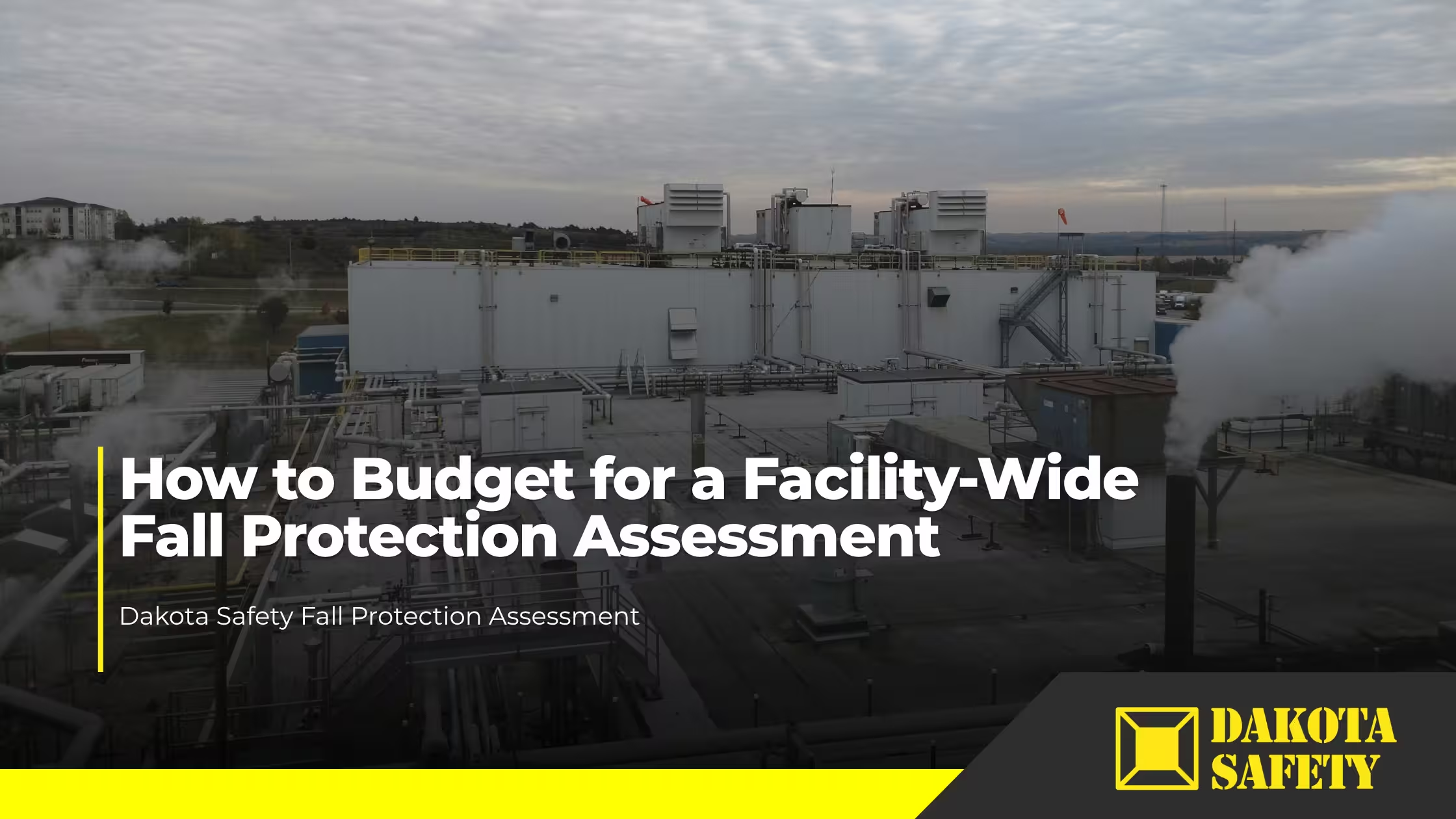


You already know the rooftop has hazards. Open hatches, unguarded edges, HVAC units a few feet from a 30-foot drop. The hazards are not the question. The number is. And every vendor you have called will not print one. There is a second reason you have not pushed harder. You are quietly afraid of what a formal audit might put in writing.
That fear is reasonable. It is also expensive. The hazard exists whether or not anyone documents it, and an unassessed hazard is still a liability you carry on the books with no plan attached.
So here is the honest math nobody in this industry publishes.
Quick Answer
A facility-wide fall protection assessment usually costs far less than buyers expect. The verified industry benchmark for a full-facility EHS compliance audit is $6,000 to $20,000 (Nimonik), but that figure covers broader scope than the rooftop-specific work most facility managers actually need. A preliminary review from overhead imagery is often complimentary. Either way, the cost is a fraction of one OSHA serious citation at $16,550.
Why Fall Protection Assessment Cost Is So Hard to Pin Down
Most fall protection vendors compete on hiding the price.
Search the major fall protection vendors and you will find a wall. Every one of them describes an assessment service. Almost none of them prints a number. Most gate it behind "request a quote," "complimentary," or symbolic dollar signs.
That silence is the reason cost uncertainty stops so many facilities before they start. You cannot put a line in next year's budget for a number you have never seen.
A second reason is real. Square footage is a weak predictor of assessment cost. A 400,000-square-foot warehouse with one clean roofline can be faster to assess than a smaller plant with three roof levels, a dozen skylights, two chiller yards, and maintenance crews on the roof every week. Complexity drives the price, not floor area.
Complexity drives the price, not square footage.
The Assessment Cost Ladder
Most facilities do not need to start at the top. Think of the spend as a ladder with three rungs, and climb only as high as the decision in front of you requires.
1Preliminary review. Dakota Safety maps your rooftop from overhead imagery in Google Earth Pro, flags the obvious hazards, and returns a budgetary picture. This rung is often complimentary across the industry and is the right entry point for scoping and capital planning.
2Professional on-site audit. A qualified assessor walks the roof, verifies what imagery cannot confirm, and delivers a written report with prioritized findings. This is the rung that produces documentation you can defend.
3Comprehensive engineered assessment. You reach for it when geometry is ambiguous, when existing active systems need inspection, or when the documentation has to survive an OSHA inspection without a gap. Each rung up the ladder buys more certainty and more defensibility.
Virtual or On-Site: What Each Buys You
A virtual review and an on-site assessment answer different questions. The table below shows where each one earns its keep.
Virtual Review vs. On-Site Assessment
| Factor | Virtual Preliminary Review | On-Site Assessment |
|---|---|---|
| Cost | Often complimentary | Varies with scope and complexity |
| Turnaround | Typically within 48 hours | Days to weeks, scheduling dependent |
| What it confirms | Edges, equipment proximity, and access points from overhead imagery | Parapet height, membrane and anchor condition, and interior hazards |
| Documentation | Budgetary scoping | Defensible report that holds up to an OSHA inspection |
| Best for | Budget planning and capital scoping | Compliance documentation and ambiguous geometry |
Most facilities start virtual to build the budget, then move on-site when they need documentation that will stand up.
What a Fall Protection Assessment Actually Costs
Most fall protection vendors do not publish their assessment pricing. The third-party safety-audit numbers that are published cover broader scope than a rooftop-specific assessment requires.
The verified industry benchmark for a full-facility EHS compliance audit runs $6,000 to $20,000 (Nimonik). Rooftop-specific scoping is its own category, and the rooftop-only numbers are not published by any vendor Dakota Safety has verified. That gap is exactly what Dakota Safety's complimentary preliminary review is built to fill.
Published Assessment Cost Benchmarks
| Assessment Type | Published Benchmark Range | Source |
|---|---|---|
| Preliminary review from overhead imagery | Often complimentary | Industry practice |
| Third-party EHS compliance audit | $6,000 to $20,000 | Nimonik (verified) |
These ranges reflect general safety-audit work, not Dakota Safety pricing, and they scale with complexity rather than square footage.
What Drives the Price
Seven factors move an assessment quote up or down. Labor and expertise carry the most weight, since report writing on a comprehensive job often equals or exceeds the field hours. Travel and mobilization come next, and it is the line a preliminary overhead-imagery review eliminates entirely.
After that: facility complexity, the number of distinct hazard areas, documentation depth, reporting format, and whether a professional engineer signs the work. A photo log costs less than CAD-marked drawings, which cost less than stamped program documentation. Each step up adds cost and adds defensibility in equal measure.
Biggest Driver
Labor and expertise
Report writing can equal or exceed the field hours on a comprehensive job.
Eliminated By Imagery
Travel and mobilization
Overhead imagery lets you scope before anyone books travel.
Defensibility Adds Cost
Documentation depth
Photo logs, CAD-marked drawings, and stamped documentation are different scopes.
Do Not Confuse the Assessment With the Remediation
The assessment fee is the small number. The remediation that follows is the larger one, and the two ride different approval paths.
An assessment is opex-sized and usually clears a manager's discretionary budget. The guardrails, hatch protection, and skylight screens that follow are capex-sized and belong in the next capital cycle. The assessment report is the document that gets that remediation funded.
Most assessments steer toward guardrails for a reason. Guardrails sit at the top of the hierarchy of controls, the engineering control that protects everyone on the roof without depending on a worker to clip in and a second worker to document it. That is a stronger fix than the personal fall-arrest gear that sits at the bottom of the hierarchy.
That is the Dakota Safety doctrine: engineer the hazard, not the worker.
Dakota Safety specifies across multiple manufacturers, so the recommendation points to the right fix for your facility. Findings come back prioritized, which means you control the timeline. Worst hazards first, the rest phased across budget cycles. Phased remediation is standard practice, and it is a legitimate plan, not a shortcut.
The Math a CFO Will Recognize
Set the assessment beside the cost of the problem it prevents.
Fall protection has been OSHA's most-cited standard for 15 consecutive years, with 6,992 citations under 29 CFR 1926.501 in the final FY2025 tally. In general industry, 29 CFR 1910.28(b)(1)(i) requires fall protection at four feet, and 29 CFR 1910.29 sets the guardrail criteria. These are not obscure edge cases. They are the violations inspectors write most often.
A single serious citation currently runs up to $16,550, a willful or repeated citation up to $165,514, and a failure-to-abate penalty accrues at up to $16,550 per day. NCCI data used in OSHA's Safety Pays program puts the average direct workers' compensation cost of a fracture from a fall at approximately $54,856 (policy years 2015-2017).
Assessment Cost vs. Risk Cost
| Line Item | Cost |
|---|---|
| Preliminary overhead-imagery review | Often complimentary |
| Third-party EHS compliance audit (general benchmark) | $6,000 to $20,000 |
| One serious OSHA citation | $16,550 |
| Average direct WC cost, fracture from a fall | $54,856 |
| One willful or repeated citation | $165,514 |
Even the most expensive third-party EHS audit on that list comes in at the cost of one or two serious citations. The Dakota Safety preliminary review is a fraction of either. There is a quieter return as well. A documented, good-faith assessment is exactly the kind of proactive evidence OSHA weighs when it calculates penalty reductions, so the report can pay for itself even if a hazard slips through.
The cheapest line item in fall protection is finding out what you have.
How to Get an Accurate Quote
You do not need a polished package to start. A facility address is enough for a preliminary review, because rooftop equipment, edges, and access points are visible from overhead imagery.
When you are ready for a firm on-site quote, share what you have. Roof plans if they exist. An approximate roof count. Known access points. A sense of how often crews are on the roof. The more of that you can share, the tighter the number comes back.
What matters more than the documentation is the walk. The most accurate assessment comes from walking the roof with the people who work it. Refrigeration techs, maintenance crews, anyone whose job takes them up there regularly. They know where people actually travel on the roof, which is rarely the route a plan would predict.
The most overlooked safety aspect on almost every site evaluation is the gap between the documented access path and the path workers actually take.
That gap is what a real on-site assessment is built to find.
FAQ
How much does a fall protection assessment cost?
Most fall protection vendors do not publish pricing. The verified industry benchmark for a full-facility EHS compliance audit is $6,000 to $20,000 (Nimonik), but that covers broader scope than a rooftop-specific assessment. A preliminary review from overhead imagery is frequently complimentary, and Dakota Safety publishes that as a no-cost starting point because rooftop-only scoping is its own category that no vendor publishes pricing for.
Is a free or complimentary assessment really free?
Yes, and it is also limited by design. A complimentary preliminary review uses overhead imagery to flag hazards and scope a budget. It is a true no-cost starting point. It does not replace an on-site assessment when you need documentation that will survive an OSHA inspection.
What is the difference between a virtual and an on-site assessment?
A virtual review reads your roof from overhead imagery and identifies edges, equipment proximity, and access points. An on-site assessment verifies the conditions imagery cannot confirm, such as parapet height, membrane condition, and the state of any existing anchors. Most facilities start virtual for budgeting and move on-site for documentation.
What does it cost to fix the hazards an assessment finds?
That is a separate budget from the assessment, and it varies widely by hazard. The assessment exists to size that remediation accurately and let you phase it by priority across capital cycles, so you are funding a plan instead of reacting to a surprise.
How do I justify an assessment to my CFO?
Set the assessment fee beside one serious OSHA citation at $16,550, one willful citation at $165,514, and an average $54,856 direct workers' compensation cost for a fracture from a fall (NCCI data via OSHA Safety Pays). The assessment is a fraction of any of them, and the resulting report is documented good-faith evidence that can reduce penalties if a hazard is ever cited.
Is a fall protection assessment the same as an OSHA inspection?
No. An OSHA inspection is reactive, unannounced, and on the agency's timeline, and it can end in citations. An assessment is proactive, private, and on your budget cycle, and it ends in a plan you control.
How often should a facility be reassessed?
Industry guidance points to reassessment after roof work, after HVAC or equipment changes, or roughly every two years. New rooftop equipment is the most common trigger, since each unit added near an edge or hatch can create a hazard that was not there before.
Get Your Preliminary Hazard Assessment
Find out what your facility-wide fall protection assessment should cover.
Send us your facility address. Our team maps your rooftop from overhead imagery and can typically deliver a preliminary hazard assessment within 48 hours, complimentary, no obligation.
Overhead imagery review
Budgetary hazard scope
Remediation priority path
Call us at 866-503-7245.
Call Dakota Safety
0 comments
Stay informed
Subscribe to get all the fall protection news and updates
Unsubscribe at any time