
OSHA Skylight Protection Requirements: The Standard Most Facilities Ignore
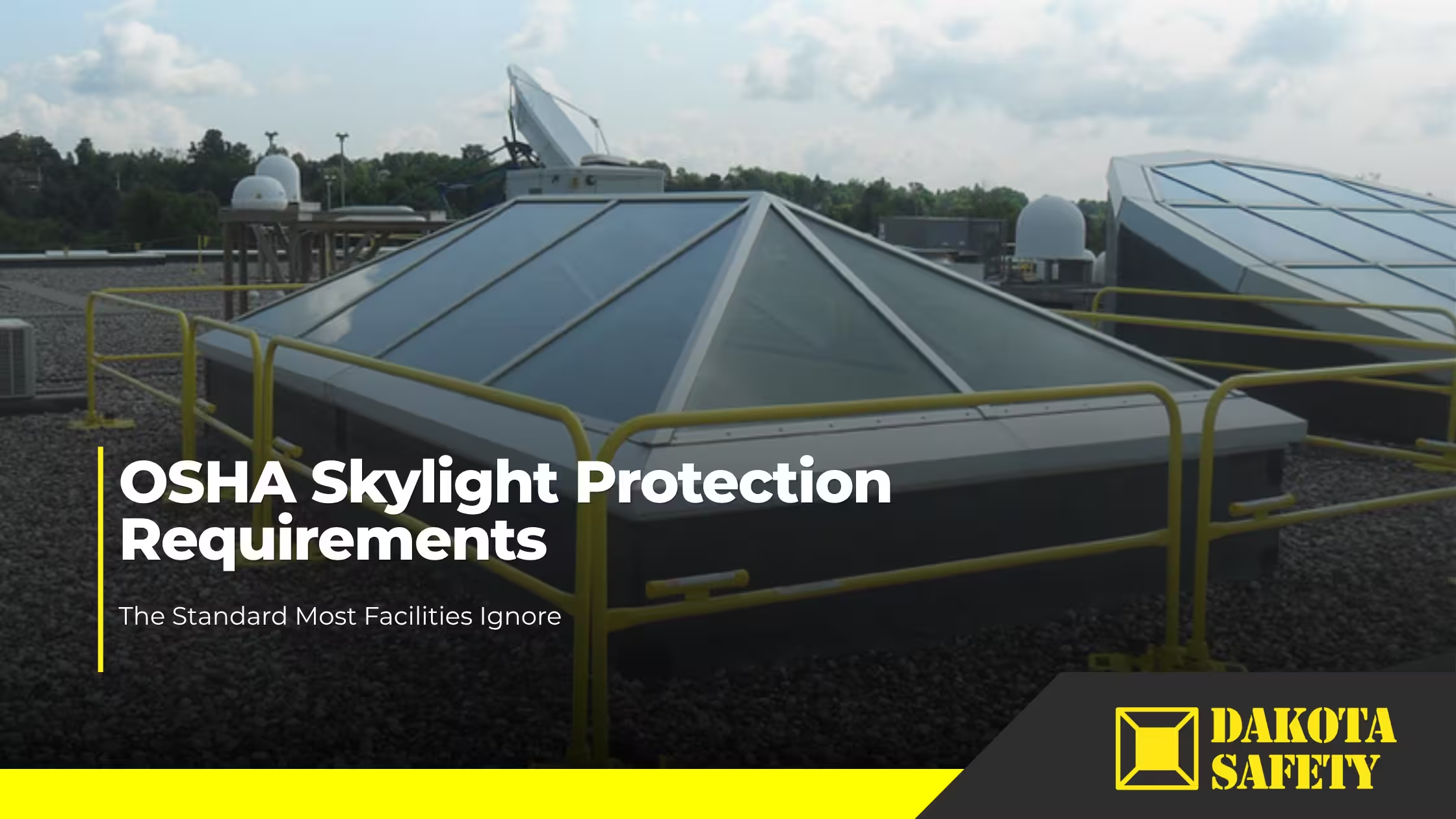


OSHA's general industry standard at 29 CFR 1910.28(b)(3)(i) writes the word "skylights" directly into the rule for holes, and most facility teams have never read that far.
The line is short. Each employee must be protected from falling through any hole, including skylights, that sits 4 feet or more above a lower level.
That parenthetical does the work. A skylight is a hole by the plain text of the standard, no matter how thick the glazing looks from the floor below.
Most rooftops we map have at least one skylight nobody has thought about as a fall hazard. It reads as part of the building, not as an opening in it. OSHA does not see it that way.
Quick answer: OSHA classifies a skylight as a hole. Under 29 CFR 1910.28(b)(3)(i), employees must be protected from falling through any hole, including skylights, that is 4 feet or more above a lower level, using covers, guardrail systems, travel restraint, or personal fall arrest. There is no minimum skylight size and no grandfather clause. The construction standard, 1926.501(b)(4), applies the same rule at 6 feet.
Are Skylights Considered Holes Under OSHA?
Yes. The definition lives in 29 CFR 1910.21(b), which defines a hole as a gap or open space at least 2 inches in its least dimension. The duty lives in 1910.28(b)(3)(i), which names skylights inside the holes provision.
The two-inch figure is the only size threshold that touches skylights. There is no separate "skylight rule" that exempts small units, and the 4-foot and 6-foot numbers people quote are fall distances to the level below, not opening sizes.
So the size question resolves cleanly. A skylight, of any size, positioned where a person could fall 4 feet or more, is a hole that OSHA requires you to protect in general industry, and 6 feet or more in construction.
There is also no grandfather clause in 1910.28. A skylight installed in 1975 is treated under the same fall-protection duty as one installed last quarter whenever a worker is exposed to the hazard.
What 29 CFR 1910.28(b)(3)(i) Actually Requires
The standard lists four compliant methods, and only four. Covers. Guardrail systems. Travel restraint systems. Personal fall arrest systems.
Warning lines alone are not listed as a permissible method for skylight holes in 1910.28(b)(3)(i), which is why relying on paint, cones, or markers around a skylight does not satisfy the standard. Safety nets are not on that list for holes either. They appear elsewhere in the fall protection rules, but not for the skylight hole provision in either general industry or construction.
For facilities, the governing standard is general industry, 29 CFR 1910, with a 4-foot trigger. The construction standard, 29 CFR 1926.501(b)(4), uses a 6-foot trigger and applies when a roofer, solar installer, or contractor is performing construction work on your roof. Both can govern the same skylight on the same roof depending on who is working and why.
The criteria are specific. A compliant guardrail under 1910.29(b) stands 42 inches high, plus or minus 3 inches, and withstands a 200-pound force applied to the top rail. A compliant cover under 1910.29(e) supports at least twice the maximum intended load and stays secured against displacement.
Read the standard, not the headline. The skylight everyone walks past is the part of the roof OSHA wrote a sentence about by name.
The Skylight Cover Trap
Here is the mistake we find most often. A facility treats the skylight itself as the cover, because a manufacturer once called it strong or rated.
OSHA does not approve products. A vendor's "OSHA-compliant" label is a claim, not a clearance. In a December 2007 interpretation letter, OSHA worked the math: in its example, a skylight a manufacturer rates at 775 pounds, with no stated safety factor, legally permits a maximum imposed load of only 387.5 pounds once the mandatory two-times factor applies.
Now add a decade of ultraviolet exposure to acrylic or polycarbonate glazing. The dome that felt solid on installation day can be significantly embrittled years later, long before anyone tests it with a real fall.
That is the Skylight Cover Trap: a facility believes the hazard is handled because the skylight is "rated," when the rating never satisfied OSHA in the first place.
The trap has a second door. Many facilities default to a tie-off, a personal fall arrest system, as the fix. On a low single-story roof there is often not enough vertical clearance below the skylight for an arrest system to stop a fall before the worker hits the floor, given the free-fall distance, deceleration distance, and safety margin in 1910.140 and typical harness and lanyard instructions. The default fix becomes the wrong fix.
Why the Hierarchy of Controls Picks the Answer for You
The four methods are not equals. The NIOSH Hierarchy of Controls ranks them, and the ranking is the decision logic.
A guardrail around the skylight is an engineering control. It is passive. It works whether or not the worker was trained, clipped in, or paying attention. It protects the HVAC tech, the roofer, the inspector, and the snow-removal crew the same way.
A compliant cover or screen is also passive, provided it meets the twice-the-load test. Travel restraint and personal fall arrest sit lower because they depend on a worker putting on equipment correctly, every visit, with no missed steps.
A guardrail works at 2 AM when nobody is watching. A harness only works if the person wearing it did four things right in sequence.
That is the Dakota Safety doctrine:
Engineer the hazard, not the worker.
Why Facilities Miss the Skylight
The reasoning is almost always the same. Nobody goes up there.
Except people do. Roofs get accessed for HVAC service, leak repair, solar work, telecom installs, inspections, and snow removal. The workers who fall through skylights are frequently not roofers at all. They are maintenance staff and contractors sent up for a few minutes on a roof that looked safe.
From the roof, the skylight reads as part of the architecture, not as a fall hazard, which is why even experienced staff underestimate it.
OSHA's enforcement record reflects this. Fall protection under 1926.501 has been the most-cited OSHA standard for 15 consecutive years, with 6,992 citations in the final FY2025 tally. Skylight falls sit inside that enforcement ecosystem, and recent OSHA cases tie unprotected skylights to six-figure proposed penalties.
The duty also applies immediately. OSHA has held that brevity of exposure is not a defense. A worker on the roof for five minutes is owed the same protection as one up there for a shift.
Skylight Protection Methods Compared
| Method | Type | Worker action required | Clearance dependency | Best fit for skylights |
|---|---|---|---|---|
| Guardrail around the skylight | Engineering control, passive | None | None beyond guard height | Frequent access, clustered or opening units, any clearance |
| Compliant cover or screen | Engineering control, passive | None | None beyond cover capacity | Low domes, preserving daylight, no opening mechanism |
| Travel restraint | Administrative plus PPE | Wear and connect every visit | Requires suitable anchorage layout and lanyard length | Limited cases where passive options are impractical |
| Personal fall arrest | PPE | Inspect, anchor, connect every visit | Requires sufficient fall clearance below skylight to arrest before impact | Last resort; fails where clearance below is too short |
How to Find Your Skylights Before OSHA Does
You cannot decide the right control from the ground. The answer depends on conditions you can only read from the roof: domed versus flat glazing, clearance to the level below, access frequency, clustering, and the roof membrane and warranty.
Dakota Safety assesses and specifies passive fall protection, and we work across multiple manufacturers to match the method to the roof rather than to a single product line. We map a rooftop from overhead imagery using Google Earth Pro, mark every opening, and flag exposure within 15 feet of an unprotected edge or hole. We do not install. We tell you what the roof needs and which compliant method fits each skylight.
For most facilities the answer is a non-penetrating guardrail around the skylight or a compliant screen, both passive, both protecting everyone who steps onto that roof. The SafetyRail 2000 system uses 95-pound cast iron bases and 1-5/8 inch galvanized tubing to meet the 200-pound load requirement without penetrating the roof membrane.
The skylight is either protected, or it is a citation that has not been written yet.
Frequently Asked Questions
Are skylights considered holes under OSHA?
Yes. 29 CFR 1910.21(b) defines a hole as a gap at least 2 inches in its least dimension, and 1910.28(b)(3)(i) names skylights inside the holes provision. A skylight 4 feet or more above a lower level must be protected in general industry.
At what height does the skylight requirement start?
Four feet above a lower level in general industry under 1910.28(b)(3)(i). Six feet in construction under 1926.501(b)(4). Both can apply to the same roof depending on who is working and what work they are doing.
Does OSHA have a minimum skylight size?
No. There is no skylight-specific size threshold. The only dimensional figure is the 2-inch least dimension in the definition of a hole. Skylights are named explicitly regardless of size.
Can the skylight itself count as an OSHA-compliant cover?
Only if it supports at least twice the maximum intended load and is documented to do so. A manufacturer's "OSHA-compliant" or load-rated label is a claim, not an OSHA endorsement. OSHA's 2007 interpretation showed, in its example, a 775-pound rating with no safety factor legally permits only 387.5 pounds.
Is a tie-off the right way to protect a skylight?
Often not. Personal fall arrest sits at the bottom of the hierarchy of controls because it depends on a worker connecting correctly every time, and on many low roofs there is not enough clearance below the skylight to arrest a fall before impact. A passive guardrail or compliant cover is preferred.
What does OSHA skylight protection cost?
Cost varies widely based on the number of skylights, roof conditions, and the method each one needs. Publishing a single "price per skylight" number would mislead, because the right figure depends heavily on roof conditions and the method each opening needs. The faster path is a complimentary preliminary assessment that maps your skylights and shows you which compliant method each one requires.
Do state OSHA plans have stricter skylight rules?
Some do. California's Cal/OSHA standard is among the most prescriptive skylight rules in the country, and Washington and Oregon also carry skylight-specific language. Multi-state facilities should confirm the applicable state plan before assuming one skylight policy covers every location.
Send us your facility address.
Our team maps your rooftop from overhead imagery and can typically deliver a preliminary hazard assessment within 48 hours, complimentary, no obligation.
Call 866-503-7245
0 comments
Stay informed
Subscribe to get all the fall protection news and updates
Unsubscribe at any time