


A service technician climbs onto a 9-foot air-cooled data center chiller, opens the access panel to check refrigerant pressures, and clips a 6-foot lanyard to the unit's frame. The roof deck sits 9 feet below his boots. If he slips and the energy absorber deploys exactly as designed, he hits the deck before the system arrests anything.
That is the engineering reality on rooftop chiller maintenance, and OSHA has been telling employers it knows since June 12, 2020. Active fall protection — harnesses, lanyards, and self-retracting lifelines — fails on data center chiller tops for three independent reasons. The regulation no longer permits it. The physics will not allow it. And on the roof, there is nothing above the chiller to anchor to.
Each disqualifier stands alone. This article walks all three.
Quick Answer: Active fall protection systems do not work on data center rooftop chillers because they fail three independent tests. OSHA's June 12, 2020 interpretation letter closed the "infrequent and temporary" exemption for traveling service technicians at 29 CFR 1910.28(b)(13)(iii)(A). A 6-foot shock-absorbing lanyard requires about 18 feet of fall clearance, but the work surface on top of a typical chiller sits only 8 to 10 feet above the roof deck. And the chiller is usually the highest structure on the roof, with nothing above the worker rated for fall arrest loads. The defensible engineering control is a passive guardrail mounted to the chiller frame.
The OSHA Argument: The 2020 Interpretation Letter Closed the "Infrequent and Temporary" Exemption
For years, mechanical contractors and facility teams ran on a comfortable assumption. If the work was brief, occasional, and well away from the roof edge, the "infrequent and temporary" exemption at 29 CFR 1910.28(b)(13)(iii)(A) covered them. No tie-off, no PFAS, no guardrail. A quick check in and out, and the exemption did the rest.
That assumption ended on June 12, 2020.
In an interpretation letter from Patrick J. Kapust, OSHA's Acting Director of the Directorate of Enforcement Programs, to Timothy Brink at the Mechanical Contractors Association of America, OSHA addressed the case of a traveling service technician performing brief rooftop equipment inspections. The specific scenario involved an air conditioning unit inspection, but the principle maps directly to data center chiller service: a technician travels between sites, each rooftop visit lasts an hour or two, and the work itself is brief.
The task may be temporary. The exposure pattern is not.
OSHA's answer was direct: "Although the work performed in the scenario noted above is temporary, it is not infrequent because the employee, travelling from jobsite to jobsite, is exposed to possible fall hazards every day or multiple times a day."
The agency pinned down both definitions from the preamble to the final rule (81 FR 82513). "Temporary" means the duration of the task is brief, short enough that installing conventional fall protection would take longer than doing the work. "Infrequent" means the task is performed on occasion, on an irregular basis, not as a routine part of the worker's job. A technician whose week is rooftop equipment maintenance, day after day, is not infrequent. The task is temporary. The exposure pattern is not.
Read the letter carefully on this point. OSHA does cite "monthly or quarterly replacement of batteries or HVAC filters" as an example of an infrequent task in the abstract. The exemption fails for the MCAA technician because of the cross-site daily exposure pattern, not because filter changes are inherently disqualifying.
For a data center, the practical read is unforgiving. The contractor servicing your chillers covers other rooftops too. Their exposure is daily. The exemption is gone. And the fall protection clock starts the moment a boot touches the chiller, separate from any analysis of the roof edge. Chiller-top work triggers the general industry duty at 29 CFR 1910.28(b)(1)(i) independently, which requires protection from any fall of 4 feet or more to a lower level.
Now to the physics.
The Physics Argument: 18 Feet of Clearance That Data Center Chillers Don't Have
A shock-absorbing lanyard is an elegant piece of engineering. It is also bound by simple arithmetic.
between sites, each rooftop visit lasts an hour or two, and the work itself is brief.
The system does not arrest the fall. It documents it.
OSHA's answer was dire
For a worker tied off with a standard 6-foot ANSI Z359.13 lanyard, the required clearance below the anchor point breaks down roughly as follows:
- Lanyard length: 6 feet
- Energy absorber deployment: up to 3.5 feet
- D-ring shift as the worker repositions: about 1.5 feet
- Worker height below D-ring: about 5 feet
- Safety factor: about 3 feet
- Total clearance required below anchor: about 18 feet (industry sources cite 17 to 18.5 feet depending on the safety factor assumed)
Now look at the chiller. A typical air-cooled data center chiller in the 140 to 500 ton range stands roughly 8 to 9 feet tall. Trane RTAC and RTAF, Carrier AquaForce 30XV, Daikin Trailblazer and Pathfinder, York YVAA. They cluster between 88 and 110 inches of overall height. Rooftop units are often mounted on structural rails with vibration isolators, which lifts the work surface another foot or two above the roof deck, but never enough to close the clearance gap.
That 18-foot clearance is measured below the anchor point. For the math to work, the anchor has to sit at or above the worker's D-ring. On a chiller, the only available place to anchor is the chiller's own structural frame, which sits at the worker's feet or below.
From the worker's feet to the roof deck is the chiller height itself, 8 to 10 feet on a typical unit. That is less than half what a 6-foot lanyard requires. And anchoring below the D-ring makes the problem worse. The worker free-falls the full distance from D-ring to anchor before the lanyard catches, before the energy absorber even starts to deploy.
The math doesn't close. The worker contacts the roof deck before the system arrests anything. This is not a training issue. It is not a worker behavior issue. It is geometry.
Leading-edge self-retracting lifelines are engineered for use with the anchor below the D-ring, which addresses part of the geometry problem. They still typically require 9 to 14 feet of clearance after deployment, plus worker height. On the tallest chillers, with an LE SRL mounted high on a supplemental anchor structure, the math gets marginal. On a standard 8-foot unit with a frame anchor, the math doesn't get there at all.
The Anchor Problem: There Is Nothing Above the Chiller to Anchor To
Engineered roof anchors do exist. Plenty of data center roofs have them. They are designed for workers on the roof deck. The worker stands on the membrane, the anchor sits at or near the deck, and the geometry works for that application.
That arrangement does not work for chiller-top maintenance. The worker is up on the chiller, 8 to 10 feet above the deck. A deck-level anchor sits below the worker's feet, which is the wrong direction for fall arrest. For a lanyard to function, the anchor has to be at or above the D-ring.
The only practical anchor location for chiller-top work is somewhere above the chiller. The chiller itself doesn't provide it. The unit is typically the highest structure on that part of the roof, and the chiller's structural frame is not engineered or rated as a 5,000-pound fall arrest anchor under 29 CFR 1926.502(d)(15) without OEM-specific certification that most manufacturers don't include.
The common manufacturer recommendation, when fall protection comes up at all, is to build a separate platform structure around the unit. That moves the problem off the chiller and into the cost and structural review of a built platform. It is essentially the same answer this article arrives at, by a longer route.
The next obvious workaround, bringing a lift up onto the roof, runs into its own problems. Scissor lifts and boom lifts are common on slab-on-grade chiller yards. They are not realistic on a data center roof. Getting a JLG onto a roof means a crane lift, structural review, and load-spreading mats on a deck that was never designed for the role. In four decades of specifying rooftop fall protection, we have never seen it done.
Rolling stairs sometimes show up on roofs for light tasks: clearing debris off the coils, hosing cottonseed out of the condenser fins in farm country, a quick visual check. They are useful for that. They are not a maintenance platform, and they leave the technician's hands and tools exposed at the top.
Even if a lift could be staged on the roof, OSHA closes the workaround. 29 CFR 1926.453(b)(2)(iii) prohibits "belting off to an adjacent pole, structure, or equipment while working from an aerial lift." The technician cannot step from the basket onto the chiller while remaining tied to the lift, and cannot use the chiller as the anchor.
The only structures tall enough to make a lanyard work would have to be built specifically for that purpose. That brings us to engineered overhead anchor systems, which fail their own test.
Why Overhead Anchor Systems Aren't a Real Alternative
A rigid overhead anchor, engineered tall enough to make a lanyard work, has to put the anchor about 18 feet above the chiller top. On an 8-foot chiller, that means a free-standing steel structure roughly 26 feet above the roof deck.
The structural loads alone disqualify most data center roofs. A 5,000-pound point load sitting 26 feet in the air above a live server hall is a structural engineering problem before it's a fall protection problem. Roof beams have to be re-evaluated, server loads below have to be accounted for, and the install itself has to happen on a facility that does not shut down.
Each post penetration is a roof warranty event. Single-ply membrane manufacturers require factory-trained installers and warranty riders for new penetrations, and the penetration is permanent.
Then there's the maintenance burden. ANSI Z359.6 and 29 CFR 1910.140 require annual inspection of engineered anchor systems by a Qualified Person, written rescue plans for every PFAS-protected access, and documented retraining for every technician who uses them.
The system can be built. It is expensive, slow, and creates a long compliance tail.
The cleaner answer is to put the guardrail where the worker actually stands.
The NIOSH Hierarchy Resolves This Cleanly
NIOSH's Hierarchy of Hazard Controls places engineering controls above personal protective equipment for a reason. Engineering controls remove the hazard. PPE only manages exposure to it.

A guardrail works at 2 AM when nobody is watching.
A guardrail mounted to the perimeter of the chiller top is the engineering control. The worker steps up to service the equipment, and the work surface is enclosed at 42 inches per the 29 CFR 1910.29 specs. The system does not depend on worker behavior, anchor inspection, harness fit, rescue planning, or training currency. It removes the hazard without relying on any of it.
The chiller-top application is a textbook example of why the hierarchy ranks the way it does.
What an Equipment-Mounted Chiller Guardrail Looks Like in Practice
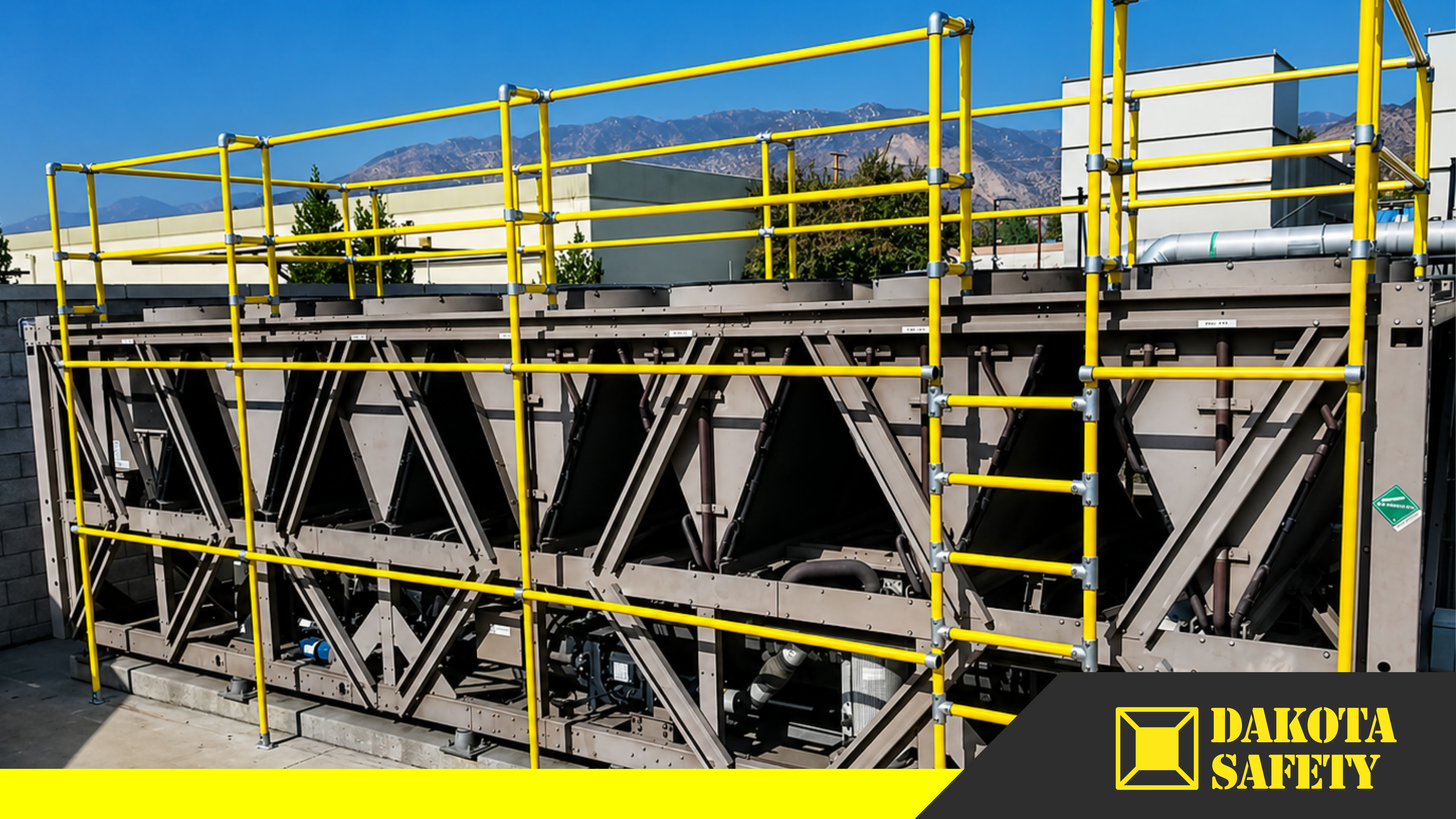
Dakota Safety's EquipGuard attaches mechanically to the chiller's factory structural rails. No drilling into the casing. No voiding the chiller warranty. No penetrating the roof. The brackets are built to the specific dimensions and structural geometry of the chiller on the roof, which means EquipGuard integrates with units from any major manufacturer, Trane, Carrier, Daikin, Johnson Controls, or otherwise.

A typical installation includes a continuous 42-inch top rail, a mid-rail, and a toe board, with a self-closing gate at the service access point. The system meets 29 CFR 1910.29 dimensional and load criteria. It is modular, which means the configuration adapts to the chiller, and the components can be reconfigured to a replacement unit later if the chiller is swapped out.
The technician carries his tools up the integrated ladder, walks through the self-closing gate, and works inside a 42-inch OSHA-compliant perimeter. No lanyard math. No rescue plans. He fixes the chiller and walks out. That is the difference between a guardrail kit purchased from a catalog and a system specified by people who have worked around the equipment.
Spec It at Chiller Selection, Not After the Citation
JLL projects roughly 100 GW of new data center capacity coming online between 2026 and 2030, representing about $1.2 trillion in real estate asset value. Hundreds of facilities are being designed right now. The chiller orders are being written. The fall protection plan, in most cases, is not.
The cost asymmetry is significant. EquipGuard specified at chiller selection is a line item in the equipment package, installed before the unit ever sees rooftop service. Retrofitting after construction means returning to a live facility, coordinating with operations, working around running plant, and absorbing the time of every party involved.
For new construction, the right window is the MEP design phase, when the chiller model is being selected. For existing facilities, the right window is now, before the next service contractor refuses to send a technician up.
Active vs. Passive Fall Protection for Data Center Chillers: Comparison
| Factor | Active PFAS (Harness + Lanyard) | Passive Guardrails (Equipment-Mounted) |
|---|---|---|
| OSHA compliance for traveling technicians | Fails. The 2020 interpretation letter disqualifies the "infrequent and temporary" exemption. | Compliant. 29 CFR 1910.29 guardrail criteria met at the point of exposure. |
| Fall clearance requirement | About 18 feet needed. Only 8 to 10 feet are available on a typical chiller. | Not applicable. The barrier prevents the fall. |
| Anchor availability on roof | None. The chiller is usually the highest structure on the deck. | Not applicable. Guardrail is the engineering control. |
| Lift access | Impractical. Crane lift and structural review required to put a lift on the roof. | Not applicable. Guardrail is permanently installed on the chiller. |
| Roof or chiller penetration | Yes, for overhead anchor towers. Voids most single-ply membrane warranties. | No. Mechanically attached to chiller structural frame. Never penetrates roof or chiller casing. |
| Annual recertification | Required. ANSI Z359.6, written rescue plans, and retraining. | Not required. Passive system, periodic visual inspection only. |
| Worker training required | Yes. Every technician, every visit. | Minimal. No specialized training for passive protection. |
| Depends on worker behavior | Yes. Harness fit, anchor selection, rescue planning. | No. Works regardless of training currency or behavior. |
| Install timeline | Weeks to months. Structural engineering, roof work, permitting. | Days. Modular, mounts to existing chiller frame. |
Three Actions for Data Center Operators This Quarter
1. Inventory every chiller
Record height, manufacturer, model, and the current fall protection arrangement at each unit on every facility roof.
2. Audit the program
Compare your fall protection program against OSHA's June 12, 2020 interpretation letter. Flag any reliance on the "infrequent and temporary" exemption for traveling service technicians.
3. Add guardrails to the spec
Include equipment-mounted guardrails in the specification package for every new chiller purchase. For existing chillers, request a preliminary EquipGuard layout from a qualified specifier.
Request a Preliminary Layout for Your Chiller
Send the chiller make, model, and unit height. Dakota Safety can typically deliver a preliminary EquipGuard layout and quote within 48 hours. No obligation. No site visit required for the preliminary layout.
Frequently Asked Questions About Data Center Chiller Fall Protection
Do rooftop chillers need fall protection?
Yes. The top of a rooftop chiller is a walking-working surface under 29 CFR 1910.28(b)(1)(i). Any fall of 4 feet or more to a lower level triggers the fall protection requirement, and most data center air-cooled chillers stand 8 to 10 feet tall. A technician steps onto a regulated fall hazard the moment a boot touches the unit.
Does OSHA's "infrequent and temporary" exemption cover data center chiller maintenance?
No. OSHA's June 12, 2020 interpretation letter established that a service technician who travels between sites and is exposed to rooftop fall hazards daily is not "infrequent" under 29 CFR 1910.28(b)(13)(iii)(A), even when each individual task is brief.
What is the difference between "infrequent" and "temporary" under OSHA 1910.28(b)(13)(iii)(A)?
OSHA pinned both definitions to the preamble of the final rule at 81 FR 82513. "Temporary" means the duration of the task is brief, short enough that installing conventional fall protection would take longer than doing the work. "Infrequent" means the task is performed only on occasion, on an irregular basis, not as a routine part of the worker's job. A technician whose work is rooftop equipment maintenance, day after day, is not infrequent.
How much fall clearance does a 6-foot shock-absorbing lanyard need?
Approximately 18 feet below the anchor point. The calculation includes the 6-foot lanyard, up to 3.5 feet of energy absorber deployment, about 1.5 feet of D-ring shift, the worker's height below the D-ring, and a safety factor. Industry sources cite a range of 17 to 18.5 feet depending on the safety factor assumed.
How tall are typical data center rooftop chillers?
Most air-cooled chillers used in data centers (140 to 500 tons) measure 8 to 9 feet tall. Trane RTAC and RTAF, Carrier AquaForce 30XV, Daikin Trailblazer, and York YVAA all fall within this range. Some portable or specialty units reach 13.5 feet, but standard installations stay between 7.5 and 10 feet. Rooftop units are typically mounted on structural rails with vibration isolators, which adds another foot or two above the roof deck.
Can a scissor or boom lift be used on a data center roof to access chillers?
No, not as a practical matter. Lifts are common at slab-on-grade chiller yards. They are not used on data center roofs because there is no realistic way to get one up there short of a crane lift, and the roof structure is rarely engineered for the point loads of a lift driving across the deck. Even if a lift could reach the chiller, 29 CFR 1926.453(b)(2)(iii) prohibits belting off to the chiller from inside the lift, which closes the obvious workaround.
Will an equipment-mounted guardrail void the chiller manufacturer's warranty?
Properly designed equipment-mounted guardrails attach to the chiller's existing structural frame, not to the casing or the roof. EquipGuard is engineered to integrate with chillers from major manufacturers including Trane, Carrier, Daikin, and Johnson Controls without modifying the unit. The system mounts to factory-rated structural rails, so the chiller's roof panels and warranty surfaces remain undisturbed.
How much does an equipment-mounted chiller guardrail system cost?
Pricing depends on chiller size, model, and configuration. Dakota Safety provides complimentary preliminary layouts and quotes within 48 hours. Send the chiller make, model, and unit height to get started. Equipment-mounted guardrails typically cost a fraction of engineered overhead anchor systems, and they eliminate the recurring annual inspection, rescue plan, and retraining costs that active systems carry.
Does OSHA require a written hazard assessment when fall protection includes PPE?
Yes. When the fall protection strategy includes personal fall arrest systems, travel restraint, or positioning devices, 29 CFR 1910.132(d)(1)-(2) requires the employer to assess the workplace, select appropriate PPE, communicate the selection to the employee, and certify the assessment in writing. OSHA's March 28, 2024 interpretation letter confirmed the written certification requirement.