
Fall Protection for Food Processing: OSHA, FDA & Corrosion


Quick Answer: Food processing plants need fall protection that satisfies OSHA's 4-foot general industry trigger under 29 CFR 1910.28 without compromising FDA sanitary design requirements under 21 CFR Part 117. Non-penetrating, hot-dip galvanized ballasted guardrail systems solve both problems by protecting workers from falls while preserving roof integrity, reducing contamination pathways, and resisting corrosion from washdown overspray.
The wrong guardrail material does not just fail. In food processing environments, it can fail invisibly, standing upright while losing the load capacity OSHA actually requires.
The Rail That Broke Off In My Hand
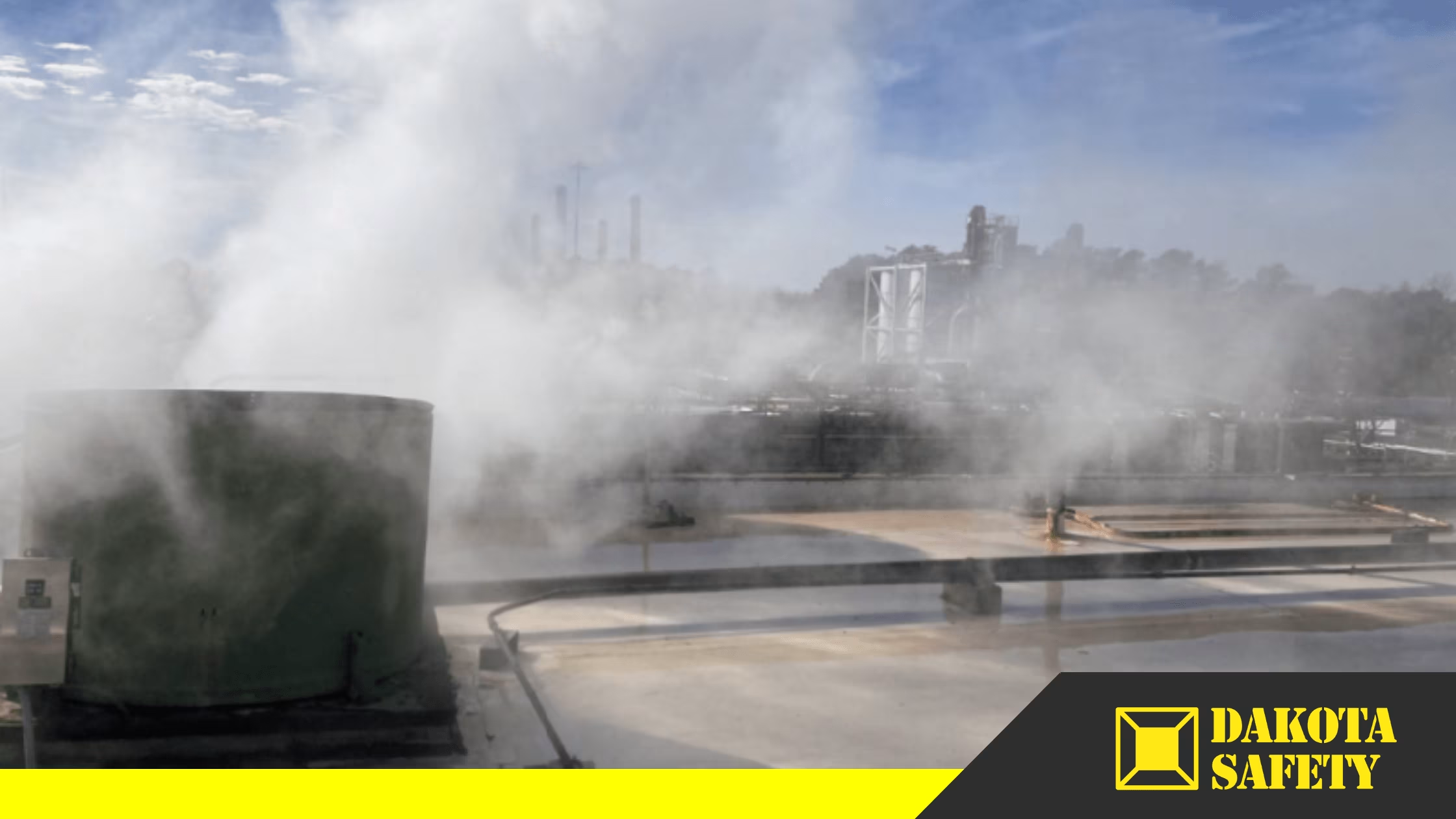
A few years back I walked the rooftop of a food plant where the exhaust steam was saturating every surface up there every shift. The powder-coated ballasted guardrail looked compliant standing up. The first rail I touched broke off in my hand, and that day the steam wasn't even running.
Had a service tech stopped at that section to take a phone call and leaned against the rail, they would have fallen 30 feet to the ground without a second of warning. The hot-dip galvanized section a few yards away, exposed to the same chemistry for the same number of years, was as solid as the day it was installed. The lesson stuck with me.
The rail keeps standing. The load capacity has already left.
This is the part of food processing fall protection that planning often overlooks. The wrong material does not just fail. It fails invisibly, passing visual inspection as compliant while quietly losing the load capacity OSHA actually requires.
Fall Protection in Food Processing: The Dual-Compliance Problem
Food processing facilities face a regulatory burden that fall protection planning often treats as a single OSHA problem. OSHA requires you to protect workers from falls. FDA requires your facility to protect food from contamination. When you install the wrong fall protection system, you solve one problem and create another.
A harness anchored through a TPO membrane two years ago is fine until the flashing starts to leak. A leak above a packaging line is an FDA conversation. A powder-coated ballasted guardrail in an overspray environment is compliant on inspection day and gone the next time the steam runs. Both failures look like fall protection problems on the surface. Both end up on a different regulator's desk.
Why Food Processing Plants Are Different
Facility reality: Every roof penetration is a future FDA conversation.
Food processing facilities are not standard industrial buildings. Washdown protocols push chemical overspray through ventilation systems and onto rooftop equipment. Chillers, RTUs, ammonia condensers, and cooling towers require regular maintenance access. Single-ply membrane roofs, including TPO, EPDM, and PVC, dominate commercial food-plant construction, and unauthorized penetrations can void or restrict manufacturer warranties.
Add temperature extremes from cold storage adjacencies, aggressive cleaning chemicals such as peracetic acid and chlorinated sanitizers, and the reality that any corrosion debris above a production line is a potential physical contaminant. The result is an environment where standard guardrail decisions carry consequences most safety catalogs never mention.
The OSHA Framework: 29 CFR 1910 Subpart D
Food processing plants fall under general industry standards, not construction. This distinction matters because several articles incorrectly cite construction standards, 29 CFR 1926, for permanent food facilities.
- 29 CFR 1910.28(b)(1)(i): Any walking-working surface with an unprotected edge 4 feet or more above a lower level requires a guardrail system, safety net, or personal fall protection. That 4-foot threshold puts most chiller decks, packaging mezzanines, and rooftop service walkways in scope.
- 29 CFR 1910.28(b)(6): Fall protection is required near dangerous equipment even below 4 feet. Workers above open mixers, vats, or packaging conveyors need protection regardless of height.
- 29 CFR 1910.28(b)(13): Low-slope roof requirements vary by distance from the edge. Within 6 feet requires conventional fall protection; 6 to 15 feet allows designated areas for infrequent work; beyond 15 feet has the most flexibility.
- 29 CFR 1910.29(b): Guardrails must meet specific criteria: 42-inch top rail, plus or minus 3 inches, 200-pound top-rail force capacity, 150-pound midrail capacity, and smooth surfaces to prevent snagging or laceration.
Enforcement is not theoretical. Fall protection was OSHA's most-cited standard in FY2025, and OSHA's Top 10 Most Frequently Cited Standards list continues to keep fall hazards highly visible. Federal OSHA penalties remain at the 2025 maximums for 2026 after the Department of Labor's May 27, 2026 no-adjustment rule: $16,550 per serious violation and $165,514 per willful or repeated violation.
Food manufacturing, NAICS 311, runs a total recordable case rate of 3.3 per 100 full-time workers, according to 2024 BLS industry data. That is higher than the private-industry average. Dairy product manufacturing and animal slaughtering and processing report even higher injury and illness rates.
The FDA Layer That Fall Protection Planning Often Misses
FDA does not regulate guardrails. But FDA absolutely regulates how your facility is constructed, maintained, and protected against contamination.
21 CFR 117.20(b)(4)
Requires plant construction that prevents drip or condensate from fixtures, ducts, and pipes from contaminating food. A roof penetration that leaks above a production line falls inside this language.
21 CFR 117.35
Requires buildings and physical facilities to be maintained in clean, sanitary condition. Corroding steel flaking rust onto a roof above food storage creates a sanitation concern.
21 CFR 117.130
Requires facilities to identify known or reasonably foreseeable biological, chemical, and physical hazards. A roof penetration that becomes a leak path is a documentable physical-hazard risk.
The honest framing: OSHA tells you whether you need fall protection. FDA constrains what kind you can responsibly install. When your fall protection choice creates roof leaks, corrosion debris, or surfaces that cannot be cleaned, you have traded an OSHA problem for an FDA problem.
Material Selection for Food Plant Guardrails
The material decision in a food plant is not about picking the most expensive option. It is about matching the material to the actual exposure.
| Material | Relative Cost | Best Application | Limitation |
|---|---|---|---|
| Powder-coated carbon steel | Lowest | Dry interior, dry exterior, no moisture exposure. | Coating cracks at joints and impact points; base steel corrodes rapidly once breached. Not appropriate near washdown overspray or exhaust steam drift. |
| Hot-dip galvanized steel | Mid | Rooftops with overspray drift through vents, intermittent moisture, and condensation zones. | Not suitable for direct full-pressure washdown with chlorinated chemicals. |
| Aluminum | Mid-to-high | Corrosion-resistant applications where penetrating installation is acceptable. | Too lightweight for ballasted non-penetrating systems; requires roof penetration to anchor. |
| Stainless steel, 304/316 | Highest | Direct washdown zones and food-contact-adjacent installations. | Requires penetrating installation; highest capital cost. |
The practical reality for most food plants: Rooftop equipment areas, where chillers, RTUs, condensers, and cooling towers sit, are exposed to overspray drifting up through building vents, not direct washdown. Hot-dip galvanized steel, metallurgically bonded with zinc, handles this intermittent moisture exposure effectively.
Field observation: Powder-coated ballasted systems on heavy-exhaust food plant roofs can fail catastrophically while staying visually upright. A hot-dip galvanized section on the same roof, exposed to the same exhaust chemistry over the same years, can show no comparable deterioration.
When the roof membrane itself cannot be penetrated, because the warranty requires it or because a leak above a production zone is a documented FDA concern, a ballasted, non-penetrating system in galvanized steel is typically the right specification. Aluminum cannot serve this role because its lower mass does not stabilize a freestanding ballasted guardrail against OSHA's 200-pound force requirement without oversized counterweights.
The Hidden Risk: False Perception of Protection
A guardrail that looks compliant and is not is more dangerous than no guardrail at all. A worker who sees a railing in place will treat it as protection. They will lean on it. They will reach over it. They will trust it to catch them if they stumble. When the powder coat has cracked, the carbon steel underneath has rusted through, and the rail snaps off the moment weight goes against it, the worker has been given a false signal.
A guardrail that looks compliant and is not is more dangerous than no guardrail at all.
The annual visual inspection cannot detect this failure mode. The rail is still standing. The fasteners are still tight. Until someone puts force on it, the failure is invisible. That is why material selection on food plant roofs is not a cosmetic decision. It is a load-capacity decision that the OSHA inspector cannot make for you.
Why Harnesses Fall Short in Food Plants
The NIOSH Hierarchy of Controls ranks engineering controls, including passive guardrails, above PPE such as harnesses. This is not an abstract preference. It reflects operational reality in food processing:
Anchor points require roof penetrations
Under 29 CFR 1910.140, anchorages must support at least 5,000 pounds per attached employee. Finding that capacity on a food plant roof without drilling through the membrane is difficult.
Harnesses absorb moisture and contaminants
Fabric straps, D-rings, and lanyards exposed to washdown environments become difficult to sanitize.
Administrative burden is heavy
Active fall protection requires documented training, pre-shift inspection, rescue planning, and continuous compliance monitoring for every worker, every shift.
Passive guardrails work 24/7
Once installed, a compliant guardrail system protects every person on that roof without requiring any action from the worker.
When guardrails are feasible, they are the higher-order control. Reserve harnesses for situations where guardrails genuinely cannot be installed.
Common Fall Hazards in Food Processing Facilities
- Rooftop chiller and condenser service: Regular maintenance on refrigeration equipment near roof edges, often without guardrails.
- Roof hatches and ladder access: Missing self-closing gates at hatch openings, a specific OSHA requirement under 1910.28(b)(3).
- Packaging-line mezzanines: Elevated platforms above conveyors and packaging equipment, often within the dangerous-equipment threshold.
- Cooling tower decks: Service walkways around cooling towers that may be wet and near unprotected edges.
- Loading docks: Height differentials at dock edges, compounded by wet or greasy surfaces.
Each of these locations requires an assessment that considers not just the fall height, but also the material environment, cleaning protocols, and proximity to food production zones.
Specifying Fall Protection for Food Processing Facilities
For most food processing facilities, the fall protection specification decision follows a clear logic:
1. Identify the fall hazard
Height, edge exposure, equipment proximity, and access frequency.
2. Assess the environment
Direct washdown, overspray drift, exhaust steam, dry rooftop, cold storage, and chemical exposure.
3. Evaluate roof membrane
Single-ply membrane requiring warranty preservation? Penetration creates leak risk above production?
4. Match the material
Powder-coated carbon steel for dry zones only, hot-dip galvanized for overspray or exhaust exposure, and specialist review for direct-washdown zones.
5. Prioritize engineering controls
Non-penetrating, ballasted guardrails where feasible; EquipGuard enclosures for chiller and cooling tower access; self-closing gates at all hatch and ladder openings.
Schedule a Food Processing Facility Assessment
Send us your facility address. Dakota Safety will identify your fall-hazard zones and recommend a specification that satisfies both OSHA and FDA considerations.
We help food processing facilities configure compliant, non-penetrating fall protection systems that protect workers without compromising sanitary design or roof integrity.
Frequently Asked Questions
Does OSHA require guardrails in food processing facilities?
Yes. Under 29 CFR 1910.28(b)(1)(i), any walking-working surface with an unprotected edge 4 feet or more above a lower level requires fall protection. Guardrails are one of three permitted options, along with safety nets and personal fall protection systems.
Does the FDA Preventive Controls Rule regulate fall protection?
Not directly. 21 CFR Part 117 does not mention guardrails. However, it does require plant construction that prevents contamination, sanitary facility maintenance, and hazard analysis. Fall protection installations that create roof leaks, corrosion, or inaccessible cleaning zones can conflict with these requirements.
Is stainless steel required for guardrails in food plants?
No. Stainless steel is appropriate for direct washdown zones, but hot-dip galvanized steel performs well in the more common scenario of rooftop areas exposed to intermittent overspray drift or exhaust steam. Galvanized steel costs significantly less than stainless and does not require roof penetration when used in ballasted configurations.
Will guardrail installation void my roof warranty?
Penetrating installations, meaning systems that drill through the membrane, can void or restrict single-ply membrane warranties. Non-penetrating, ballasted guardrail systems sit on the membrane surface without fasteners, preserving warranty integrity.
Why are harnesses less effective than guardrails in food plants?
Under the NIOSH Hierarchy of Controls, guardrails are engineering controls while harnesses are PPE. Harnesses also require anchor points, documented training, daily inspection, and rescue planning. Those administrative burdens are eliminated by passive guardrails.
Why do powder-coated guardrails fail in food plant environments?
Powder coating is a barrier coating. When the coating cracks at joints, impact points, or fastener locations, moisture and chemistry reach the underlying carbon steel and corrosion progresses unseen. In food plant rooftop environments with washdown overspray, exhaust steam, or sanitizer drift, this failure can compromise OSHA's 200-pound load requirement while the rail still looks intact. Hot-dip galvanizing protects the steel metallurgically rather than as a surface coat, which is why HDG holds up where powder coat fails.
How much does an OSHA fall protection violation cost?
Federal OSHA's 2025 penalty amounts remain applicable in 2026 after the Department of Labor cancelled the 2026 inflation adjustment. A serious violation carries a maximum penalty of $16,550. Willful or repeated violations can reach $165,514 per instance. Failure to abate adds up to $16,550 per day past the abatement deadline.
What does fall protection cost for a food processing facility?
Cost varies by facility size, number of fall-hazard zones, rooftop equipment layout, and material specification. Factors include linear footage of guardrail needed, number of access gates, chiller enclosure requirements, and whether the system is powder-coated for dry zones or hot-dip galvanized for overspray zones. Contact Dakota Safety for a complimentary assessment with a project-specific estimate.
Does OSHA inspect food plants more frequently for fall hazards?
OSHA's National Emphasis Program on Falls, CPL 03-00-025, has no expiration and covers fall hazards across all industries. OSHA Regional Emphasis Programs also target food manufacturing in several regions, and OSHA inspection guidance for animal slaughtering includes slips, trips, and falls as a focus hazard.
0 comments
Stay informed
Subscribe to get all the fall protection news and updates
Unsubscribe at any time