
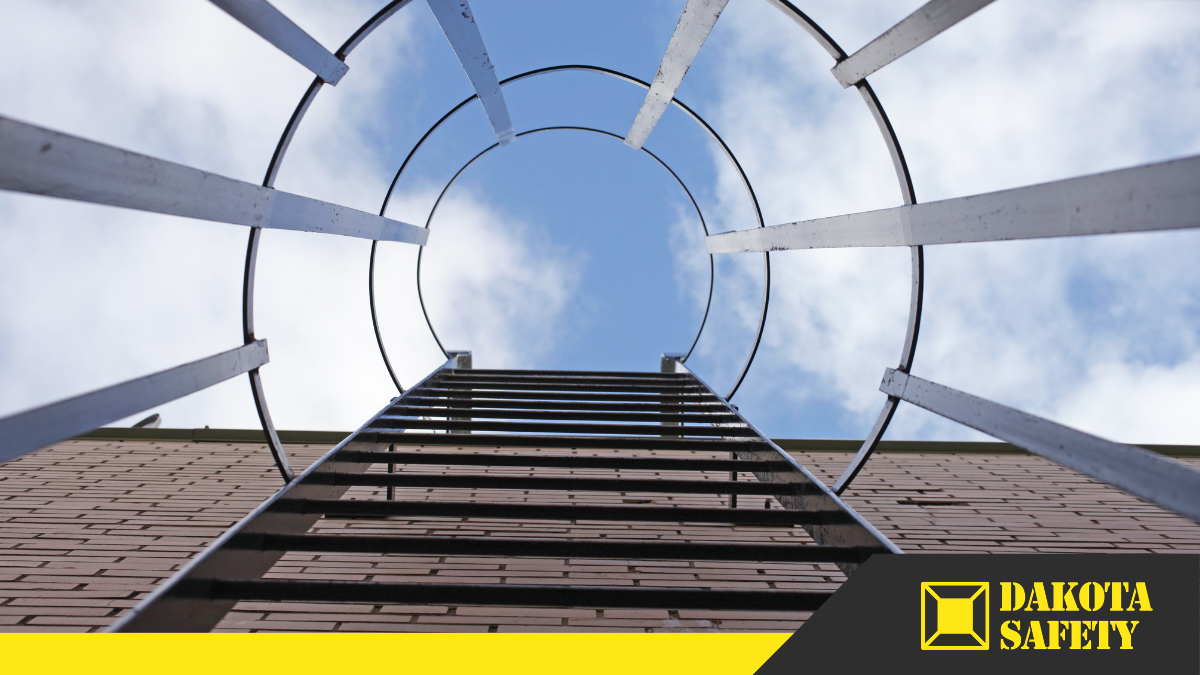


By November 18, 2036, every fixed ladder over 24 feet in a general industry facility must be equipped with a personal fall arrest system or ladder safety system. Cages and wells — the standard for decades — will no longer satisfy OSHA §1910.28(b)(9). Most facilities are treating this as a retrofit problem: remove the cage, install a fall arrest rail, check the box.
That framing will cost a lot of facilities a lot of money. Not because the retrofit is wrong — but because it answers the wrong question.
The better question—and the one OSHA's own regulatory architecture points toward—is whether a ladder belongs at that access point at all.
OSHA's Regulatory Hierarchy Puts Stairs First
Most EHS professionals know the 2036 deadline. Fewer have read it in the context of the full Subpart D framework, where OSHA establishes a clear preference order for access between levels.
OSHA §1910.25(b)(7) states it directly: standard stairs are required when operations necessitate regular and routine travel between levels, including access to operating platforms for equipment. §1910.25(b)(8) restricts alternatives like ship stairs and alternating-tread stairs to situations where standard stairs aren't feasible. Ladders, by the architecture of Subpart D, come after that.
The hierarchy matters because it reframes the 2036 decision. If your maintenance crews access the roof daily — servicing HVAC units, checking refrigeration equipment, inspecting membrane conditions — OSHA's own standards suggest the access point should have been a stairway from the beginning. Retrofitting a fall arrest system on that ladder makes you compliant. It doesn't make you aligned with the regulatory intent.
The Load-Carrying Problem Nobody Solves With Better Ladders
Here's what the 2036 conversation consistently misses.
OSHA §1910.23(b)(13) explicitly prohibits carrying any object or load that could cause a loss of balance while climbing a fixed ladder. §1910.23(b)(12) requires at least one hand grasping the ladder at all times. Those aren't suggestions. They're binding requirements.
Now consider what actually happens at a food processing plant or distribution center. A maintenance tech gets a call about a rooftop condenser unit. The repair requires a toolbox, a refrigerant recovery unit, maybe replacement parts. The ladder has a "No Loads" sticker on it. The tech looks at the sticker, looks at the 40 pounds of equipment, and does the math on how many trips it takes to shuttle everything up one piece at a time with a rope and bucket.
Most of the time, the math loses. The tools go up with the tech. Three-point contact is violated not through recklessness but through operational necessity. The access solution and the operational requirement are fundamentally incompatible, and the worker absorbs the risk.
A personal fall arrest system — the solution everyone is planning for 2036 — protects the worker from falling off the ladder. It does nothing to resolve the load-carrying problem. It does nothing to address fatigue on repeated climbs. It doesn't help when the tech needs to descend in a hurry during a refrigerant leak. A stairway solves all of those problems simultaneously, because it makes safe access the path of least resistance.
That's the insight the 2036 conversation keeps missing: systems that depend on workers continuously overriding natural behavior are not systems designed for safety. They are systems that transfer organizational risk onto individual workers and call it compliance.
Where Ladders Still Make Sense
This is not an argument that every fixed ladder should become a stairway. That would ignore real-world constraints that every plant engineer understands — structural load limitations, footprint restrictions, access points that genuinely see infrequent traffic.
Fixed ladders with personal fall arrest systems remain the right solution when spatial constraints genuinely preclude a stairway, when access frequency is truly occasional (quarterly inspections, not weekly maintenance), or when the ladder serves strictly as a secondary backup to a primary stair access point.
The distinction is between access points where people climb because it's the only option, and access points where people climb because nobody evaluated whether a stair was feasible. The 2036 deadline forces the capital expenditure either way. The question is whether that capital produces a minimally compliant ladder upgrade or a genuinely safer, more productive access solution.
Evaluating the Real Cost of Each Option
The initial capital cost of a stairway exceeds a ladder fall arrest retrofit. That's obvious and true. But total cost of ownership tells a different story.
A ladder safety system requires ongoing inspection and maintenance. It requires trained users and documented training records per OSHA's General Industry standard §1910.30. It doesn't eliminate the productivity penalty of multiple trips for tools and materials. And it doesn't address the liability exposure created every time a worker violates the load-carrying standard because the job required carrying equipment to the roof.
A stairway eliminates ongoing fall arrest inspection costs. It eliminates the training documentation burden. It allows unrestricted load-carrying, which means fewer trips, faster service calls, and less time on the roof. And it removes the liability gap between what the standard requires and what operational reality demands.
For any access point serving daily or weekly maintenance traffic, the lifecycle math favors stairs more often than initial estimates suggest. The 2036 deadline is forcing a capital investment regardless — the only variable is what that investment buys.

Making the Right Decision for Your Facility
Every facility is different. The access points that should become stairways and the ones that should get fall arrest retrofits depend on traffic frequency, structural conditions, available footprint, and operational requirements.
The mistake is treating every caged ladder the same — as a cage-removal problem rather than an access design opportunity. Some of those ladders should get fall arrest systems. Some of them should become stairs. And some facilities will benefit from a combination of both, matched to the specific conditions at each access point.

If your facility is planning for the 2036 deadline, start by evaluating what each access point actually needs to do — not just what the minimum standard requires. We assess both ladder and stair solutions for industrial facilities and can scope a preliminary recommendation based on photos and measurements, typically within 48 hours.
Andrew Miller, CSI, CDT Dakota Safety | DakotaSafety.com | 866-503-7245