
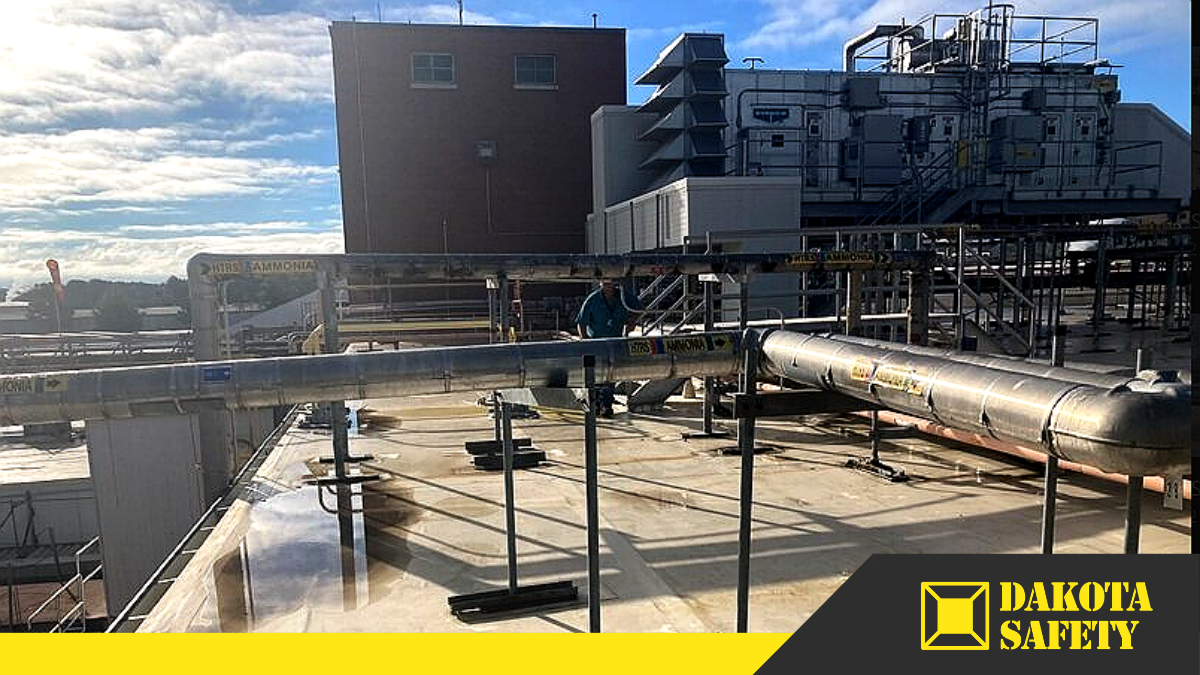


We recently completed a rooftop safety assessment at a large food processing facility: multiple buildings, multiple roof levels, mechanical equipment serviced daily. The scope was straightforward — identify the top 10 priority risks and build a phased plan the facility could fund over two to three years.
The first three priorities on the list were all the same thing. Access points.
Not roof edges. Not skylights. Not equipment perimeters. Access points — the places where workers transition from inside the building to the roof surface. That pattern held through the rest of the top 10. Six of the highest-priority safety risks at this facility were directly tied to how people got onto and off of the roof.
That ratio shows up at facility after facility. The access point is where the risk concentrates — and it's the part of rooftop safety most assessments underweight.
The Workaround That Replaced the Ladder
The highest-priority spot had a fixed ladder the plant had fabricated in-house years ago. Steep, narrow, and positioned so that getting on and off required contorting your body around structural elements. The kind of access that experienced maintenance techs tolerate but never trust.
Workers had stopped using it. Instead, they walked up a small ramp to a lower roof section and hopped onto the main roof from there. No fall protection. No guardrails. No engineered transition of any kind. It had become a main traffic route, used daily by every tech who needed to reach the mechanical equipment on the upper levels.
The proposed fix was a pair of stair installations at approximately $7,500 each. The alternative — a fully engineered platform-and-ladder system solving the same access problem — came in at about $30,000. The stairs did the same job at roughly a quarter of the cost and made the safe route faster and easier than the workaround, so workers would actually use it. OSHA §1910.25(b)(7) calls for standard stairs when operations necessitate regular and routine travel between levels. This was exactly that scenario.
The Ladder Nobody Should Climb Every Day
A second access point served a heavily trafficked section of the roof with ammonia piping, HVAC equipment, and an access door that maintenance crews used daily. The existing solution was a straight vertical ladder at the edge of an unprotected walkway. Workers climbed up and down that ladder all day, every day — carrying tools, filters, replacement parts.


During the site visit, a worker was observed sitting at the roof edge with his feet dangling over the side. The safety team saw it happen in real time.
The stair replacement for this location cost only slightly more than the vertical ladder it would replace. The conversation with the facility's safety lead came down to a simple comparison: for roughly the same investment, you can keep a ladder that requires three-point contact, prohibits load-carrying per §1910.23(b)(13), and demands constant behavioral compliance — or you can install stairs that a tech walks up with a toolbox without thinking twice.

The Access Point Nobody Designed
A third spot was worse. To reach a section of roof with heavy equipment, workers had to climb a homemade ladder that went straight up, crossed a short level platform, then went straight up again — over railing and piping. It was the only way onto that roof section, and it was, to put it plainly, dangerous.
A single stair installation eliminated the entire sequence. Same height. Same destination. No climbing over piping, no contorting around structural elements. The stair arrived pre-assembled and bolted directly to the building — no field fabrication, no complex installation.
These three access points shared the same underlying failure. Nobody asked how often workers would use the access, what they'd be carrying, or what would happen when the official route was worse than the improvised one.
The Loading Dock Problem
The fourth priority was different — a loading dock area where crews used a crane to lift pallets of filters and parts to the roof, 30 to 40 feet up. Matting extended right to the roof edge. Workers stood at an unprotected edge to receive and position the pallets. This wasn't a ladder-to-stair conversion. It required a sliding gate system that could open for pallet access and close to protect the edge. Different problem, different solution — but still an access point where workers and an unprotected edge intersected daily.
The Pattern Underneath All Six
Across six priority locations, the same pattern emerged: high-traffic access points designed or improvised for structural convenience rather than operational safety. Workers adapted. They took shortcuts, climbed things never meant for daily use, carried loads where loads were prohibited, and stood at unprotected edges because the work required it and nobody had engineered an alternative.
The 2036 OSHA deadline for caged ladders is focusing industry attention on fall arrest retrofits. That's necessary where ladders remain the right solution. But at this facility, the assessment revealed that the real risk wasn't the ladder hardware — it was the access design itself. Three of the six highest-priority fixes were stair installations, not ladder upgrades. Two were edge protection systems. One was a bridge replacement.
The total phased plan runs approximately $100,000 per year over two to three years. The stair installations — the highest-impact, highest-traffic fixes — were among the least expensive items on the list. A single stair at about $7,500 eliminates a dangerous workaround workers use every day. For that level of risk reduction, the cost is easy to justify.
Starting With the Spots That Matter Most
Every large facility has more safety needs than any single budget cycle can address. The facilities that make progress prioritize by traffic frequency and risk severity — not by what's cheapest or easiest to install.
Access points are almost always near the top of that list. A phased assessment that identifies the top 10 priorities and sequences them across two to three budget cycles makes the work manageable without deferring the highest risks.
If your facility has access points where workers are climbing homemade ladders, routing around official access, or carrying equipment where OSHA says they shouldn't — those are the spots to evaluate first. Reply with a few photos and a description, and we can typically scope a preliminary recommendation within 48 hours.
Andrew Miller, CSI, CDT Dakota Safety | DakotaSafety.com | 866-503-7245