
Industrial Fall Protection Without Production Shutdown
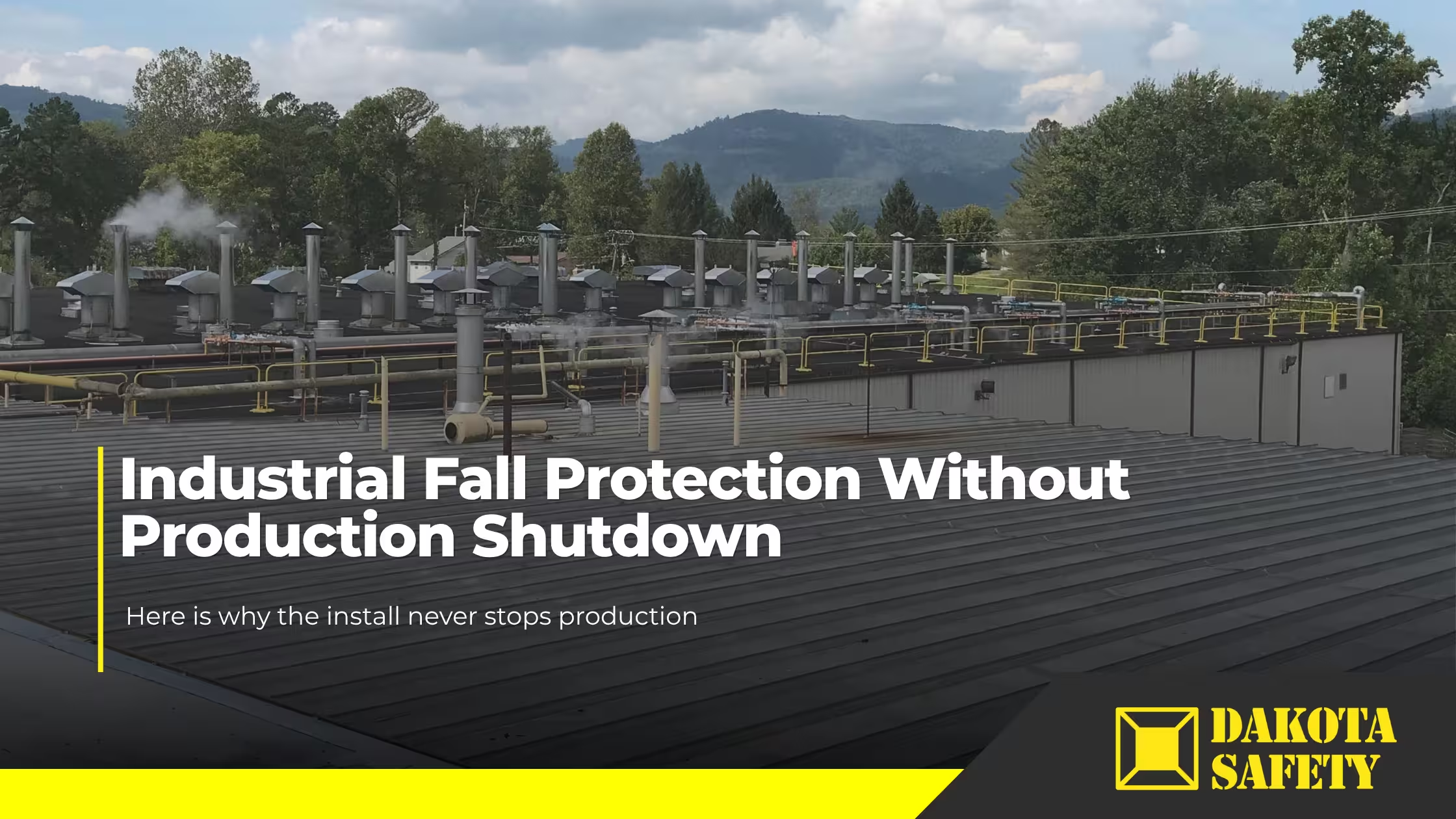


A welded guardrail retrofit on a continuous line can pull production offline for days while crews stage steel, pull hot work permits, and post a fire watch. At the downtime rates manufacturers report, that lost production is usually the most expensive part of the whole project.
The fall hazard is real. The line still has to run. Those two facts collide in every plant, warehouse, and food facility that operates around the clock.
Here is the part most operations leaders never get told. The shutdown is not caused by fall protection. It is caused by the installation method they assume they are stuck with.
Quick answer: Yes, you can add OSHA-compliant rooftop fall protection without shutting down production. Non-penetrating, ballasted guardrail systems assemble on the roof with hand tools and weighted bases. They require no welding, no roof penetration, no hot work permit, and no fire watch, so the work stays on the roof and the line below keeps running.
Why Production Shutdown Was Ever on the Table
The shutdown objection comes from a specific mental picture: a welded steel railing, cut and fabricated in place on the roof.
That picture triggers a chain of OSHA and fire-code obligations. Welding and cutting are hot work.
Under 29 CFR 1910.252, hot work near combustibles requires a written authorization, a 35-foot combustible-clearance zone, and a fire watch that stays in place for at least 30 minutes after the torch goes cold. NFPA 51B, the industry consensus standard for hot work, now recommends extending that fire watch to at least 60 minutes. Either way, that is dead time where a crew stands on your roof doing nothing but watching for smoke.
On an operating plant roof, sparks fall onto a membrane that sits directly above a running production floor. Above a food line, that adds a contamination question to the fire question. The plant manager does the math and stops the line. That math is correct, for a welded system.
The Shutdown Trigger Map
The fastest way to kill the shutdown objection is to name exactly what forces a shutdown in the first place. We call it the Shutdown Trigger Map, and it has four triggers.
Four installation triggers that can force a shutdown
1. Hot work. Welding or cutting on the roof pulls in the permit, the clearance zone, and the fire watch under 1910.252.
2. Roof penetration. A bolted or anchored system drills the membrane, which means flashing, roofer coordination, and a warranty conversation with the roofing manufacturer.
3. Heavy lift. Fabricated steel often needs a crane pick, which closes a yard, a dock, or a drive lane below.
4. Structural attachment. Anything fastened to the building frame can require engineering sign-off and inspection before the work proceeds.
A non-penetrating, ballasted guardrail trips none of the four. It assembles with hand tools on weighted bases that sit on the roof under gravity alone. No torch. No drill into the deck. No crane pick. No structural fastener.
That is the Dakota Safety doctrine:
Engineer the hazard, not the worker.
How a Non-Penetrating System Stays Compliant Without Welding
OSHA's guardrail standard is performance-based, not method-based. Nothing in 29 CFR 1910.29(b) requires welding or anchoring. It requires the installed system to meet height and load criteria.
The top rail must sit 42 inches above the walking surface, plus or minus three inches, and withstand 200 pounds of force in any outward or downward direction. A midrail is required when there is no parapet at least 21 inches high. A SafetyRail 2000 system meets all of it with 95-pound cast iron bases, 1-5/8-inch galvanized steel tubing, and a 42-inch rail height.
A ballasted guardrail meets the same OSHA criteria as a welded one. The wall holds because physics holds, not because a torch touched it.
For general industry, the duty starts at 4 feet, not the 6-foot construction trigger many maintenance teams assume. The citation is 29 CFR 1910.28(b)(1)(i). Fall protection under 1926.501 has been OSHA's most-cited standard for 15 consecutive years, with 6,992 citations in the final FY2025 tally.
How the Install Keeps the Line Running
The work that keeps production running stays on the roof, and it starts before anyone climbs a ladder. We map the rooftop from overhead imagery using Google Earth Pro, mark every exposure within 15 feet of an unprotected edge, and measure the actual edge distances from each piece of equipment. That map becomes the layout plan.
Dakota Safety's part is the front end, and it moves fast. We can typically turn around a preliminary hazard assessment within 48 hours of receiving a facility address.
The install itself is a separate clock. How long it runs depends on the roof, the layout, and the size of the perimeter. But because the system is ballasted, the crew works without hot work, without penetrating the roof, and without stopping the line, however long the job takes.
Speed Without Cutting Corners
The honest concern with any fast install is whether fast means sloppy.
It does not, because the complexity moves out of the production window and into the planning phase. The assessment, the wind and ballast review, and the layout around equipment all happen before the crew arrives. A NIOSH field study of a commercial non-penetrating guardrail measured it installing roughly 32 percent faster than a job-built rail, and every configuration it tested met the 200-pound requirement.
Ballasted does not mean unengineered. Base spacing and ballast geometry get sized to the roof's wind exposure, and not every roof is a candidate. High wind, tight setbacks, and certain sloped membranes change the answer. That is why we assess the roof before we specify a system.
How the Downtime Math Decides the Project
Operations leaders do not approve safety projects. They approve projects that survive the downtime conversation.
Published estimates of manufacturing downtime run from roughly $36,000 per hour in fast-moving consumer goods up to $2.3 million per hour in automotive, with general-manufacturing figures commonly cited near $125,000 per hour. Treat those as ranges, not a single number, because most of them measure unplanned downtime, which is a different animal than a scheduled install. But even at a fraction of those rates, a scheduled multi-day shutdown ruins a quarterly budget.
The point is the reverse of sticker shock. A non-penetrating system that goes in without stopping the line converts that downtime exposure to zero. The most expensive line item in a welded project is the one a ballasted system deletes entirely.
| Factor | Welded / penetrating system | Non-penetrating ballasted system |
|---|---|---|
| Hot work permit + fire watch | Required (1910.252, NFPA 51B) | Not triggered |
| Roof penetration / flashing | Required | None |
| Crane or heavy lift | Often required | Not required |
| Structural engineering sign-off | Often required | Not required |
| Production shutdown | Common | Avoided |
| OSHA 1910.29 compliance | Met | Met |
Scaling From One Roof to a Campus
The approach scales from one building to twenty. Because the system is standardized and the assessment is repeatable, a multi-building program runs as a phased rollout rather than one shutdown.
You prioritize by exposure, standardize the components across sites, and carry one hazard map and one as-built record per building into the compliance file. No single site has to go dark to bring the next one online.
Frequently Asked Questions
Can rooftop fall protection be installed without shutting down production?
Yes. Non-penetrating, ballasted guardrail systems assemble entirely on the roof with hand tools and weighted bases. With no welding and no roof penetration, the work stays on the roof and the production line below keeps running.
Do non-penetrating guardrails require a hot work permit or fire watch?
No. Hot work obligations under 29 CFR 1910.252 and NFPA 51B are triggered by welding and cutting. A ballasted system is mechanically assembled with no torch, so the permit, the 35-foot clearance zone, and the post-work fire watch are not triggered.
Are ballasted guardrails OSHA-compliant?
Yes, when the installed system meets 29 CFR 1910.29(b): a 42-inch top rail that withstands 200 pounds of force, with a midrail where no 21-inch parapet exists. OSHA's standard is performance-based, so a non-penetrating system that meets the criteria is as compliant as a welded one.
At what height does OSHA require guardrails in a manufacturing facility?
In general industry, the duty starts at 4 feet above a lower level under 29 CFR 1910.28(b)(1)(i). The 6-foot trigger belongs to construction work under 1926, which is why many maintenance teams apply the wrong number to plant rooftops.
Will a ballasted guardrail damage my roof membrane or void the warranty?
A non-penetrating system does not drill or fasten into the membrane, so it does not create the penetration that warranty conversations turn on. Confirm specifics with your roofing manufacturer, and have the layout reviewed so bases and ballast are placed correctly.
How much does production downtime cost during a safety install?
Costs vary widely by facility, line, and how the figure is calculated, with published manufacturing estimates ranging from tens of thousands to over two million dollars per hour. The relevant point is that a non-penetrating install scheduled around operations can avoid that downtime entirely. We start with a complimentary preliminary assessment rather than a price.
When is a non-penetrating system not the right choice?
High wind exposure, insufficient edge setback, and certain sloped or standing-seam membranes can make a ballasted system the wrong call. The assessment exists to catch those conditions before anything ships, which is why mapping the roof comes before specifying a system.
Keep production running while you close the rooftop fall hazard.
Send us your facility address. Our team maps your rooftop from overhead imagery and can typically deliver a preliminary hazard assessment within 48 hours, complimentary, no obligation.
Call 866-503-7245
0 comments
Stay informed
Subscribe to get all the fall protection news and updates
Unsubscribe at any time